
Technical Analysis Of Tensile Performance Of High-Strength Bolts
Apr 18, 2025

Our company Jinrui has a motto: "Small as a screw, safety is paramount." In practical applications, this is indeed the case – a tiny bolt plays an indispensable role. Especially in the installation and use of high-strength bolts, strict requirements are imposed on their tensile strength. To evaluate the performance grade of a bolt, we must refer to mechanical properties such as the nominal tensile strength and yield strength of the material (in accordance with national standards like GB/T 3098.1), rather than simply calculating by multiplying the cross-sectional area by a design value. The measured indicators must be compared with the performance grade ranges specified in the standards to confirm compliance. When fixing large equipment, high-strength bolts must be embedded integrally with the concrete foundation to withstand the strong vibrations generated by heavy machinery during operation and prevent connection failure. Before installation, the thread dimensions (such as pitch, major diameter, and minor diameter) of high-strength bolts must be strictly inspected to ensure they meet standards, along with the chamfer at the thread tail and the relief groove at the connection between the thread head and shank, ensuring no burrs or dimensional deviations. Traditional high-strength water-stop bolts adopt a one-time connection design and cannot be disassembled after installation, so the accuracy of the installation position must be confirmed in advance.
In the fastener industry, over 90% of threads are right-hand threads (tightened by clockwise rotation), the standard thread form used internationally. Left-hand threads are tightened by counterclockwise rotation. Given that most users are right-handed, high-strength bolts are generally designed with right-hand threads. For special applications, double-end bolts may have a mixed design (one end right-hand, one end left-hand). By rotating the middle section in a single direction, both ends can be locked simultaneously, achieving efficient fastening. This "thread rotation direction matching motion direction" anti-loosening design is typified in the left pedal of a bicycle – the left pedal uses a left-hand thread, which tightens further as the pedal is pushed rightward, preventing loosening due to vibrations and demonstrating the practicality and scientificity of mechanical design.
Heat treatment is a core process in manufacturing high-strength bolts. Since high-strength bolt materials (such as medium-carbon steel and alloy steel) have high hardness, the raw material must first undergo annealing to soften it before cold heading, improving plasticity and reducing processing difficulty. After forming, the "quenching and tempering" heat treatment process is applied to enhance the mechanical properties (tensile strength, yield strength, hardness) to the design requirements. The quality of heat treatment directly determines the final performance of the bolts, requiring strict control of process parameters such as heating temperature, holding time, and cooling medium. Although the operation may seem routine, all personnel must understand their responsibilities and master the basic principles of heat treatment (e.g., the impact of austenitization and martensitic transformation on properties) to avoid performance failures due to temperature deviations or insufficient time. As bolts may change dimensions due to thermal expansion and contraction during heat treatment, operators must use specialized measuring tools (such as micrometers and Rockwell hardness testers) to monitor thread diameter, bolt length, and surface hardness in real time, ensuring key parameters remain within tolerance ranges.
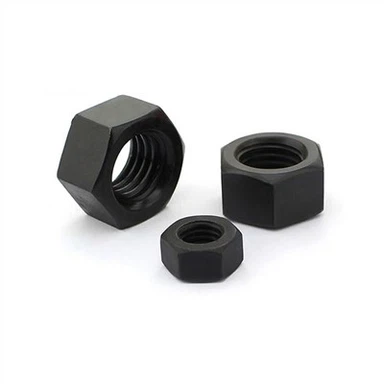
Heat-treated high-strength bolts typically have a dark gray surface, making them prone to mixing different specifications during transportation and inventory. Therefore, heat treatment furnaces should be designed with independent basket partitions and clear specification labels to prevent mixed processing of bolts of different grades and sizes, minimizing quality risks from the equipment end.
Carbon steel bolts are classified into performance grades such as 4.8, 8.8, 10.9, and 12.9 based on heat treatment (14.9-grade bolts, made of special alloy steel, are rarely used in industrial applications):
4.8-grade: Ordinary bolts made of low-carbon steel without high-strength heat treatment, suitable for general load scenarios.
8.8-grade and above: High-strength bolts (8.8-grade bolts undergo quenching and tempering of medium-carbon steel; 10.9-grade and 12.9-grade bolts use alloy steel heat treatment), suitable for high-load and strong-vibration conditions.
Take 10.9 grade bolts as an example: their nominal tensile strength is ≥1000MPa, with a yield ratio of 0.9 (i.e., nominal yield strength ≥900MPa), which must be verified through tensile tests to ensure compliance with standards. These mechanical parameters are core indicators for measuring the tensile performance of bolts and must be strictly controlled within the ranges specified by national standards to ensure the safety and reliability of engineering structures.