

How To Prevent Stainless Steel Nuts From Galling Mid-Tightening
Nov 19, 2026
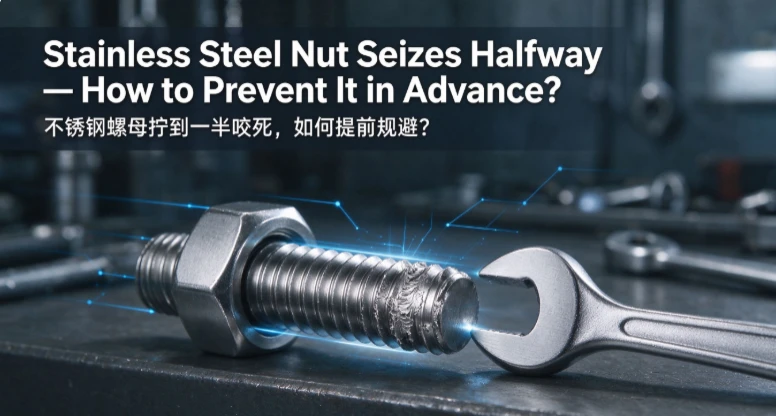
Engineers engaged in equipment assembly and maintenance have most likely encountered this frustrating issue: brand-new stainless steel bolts and nuts turn smoothly at first, but suddenly jam halfway through tightening. They cannot rotate further even with extra force. If forced, the threads will seize and gall, rendering both the bolt and nut scrap - a phenomenon commonly known as thread galling (cold welding).
Once galling occurs, it delays maintenance work and increases spare part costs. This issue happens far more frequently under high-temperature working conditions. Below we analyze the root causes of stainless steel thread galling and share practical preventive solutions to help you avoid this failure from the source.
1. Understand Why Stainless Steel Threads Gall Mid-Tightening
Many people assume galling is simply caused by excessive torque or over-tightening, which is a common misconception.
Stainless steel features good ductility and a thin passive film. During thread engagement and friction, microscopic protrusions on the thread crests scratch off the chromium oxide passive film. Fresh bare metal substrates come into direct contact. Under pressure and frictional heat, micro-welding takes place instantly on the contact surfaces, which we call cold welding.
At the early stage of turning, the contact pressure and frictional heat are low, and the passive film remains effective as an isolation layer, allowing smooth rotation. As tightening continues, the meshing area expands, contact stress rises, frictional heat accumulates rapidly, the passive film keeps breaking down, and metal thread surfaces begin to adhere, resulting in instant jamming.
Austenitic stainless steels such as 304 and 316 are more prone to galling than carbon steel. The risk multiplies under high-temperature conditions, without lubrication, or when thread tolerance deviation is large.
Other easily overlooked contributing factors:
Burrs, iron filings or contaminants on thread surfaces scratch the threads and damage the passive film during engagement;
Mismatched material combinations for bolts and nuts, or large hardness differences between stainless steel from different batches;
Excessively fast tightening speed, with no time for frictional heat to dissipate. Heat buildup accelerates cold welding;
Damaged thread profiles or tight tolerances leading to excessive interference between thread flanks.
2. Pre-Assembly Preparation: Reduce Galling Risk at the Source
Pre-treatment is the most critical step for preventing stainless steel thread galling, yet it is often skipped at assembly sites.
Thread Inspection and Cleaning Before assembly, carefully inspect the threads of bolts and nuts. Clear iron filings, oil stains, anti-rust powder and burrs trapped in thread gaps. Replace any fastener with impact damage or deformed thread profiles instead of forcing it into use. Even for visually intact threads, microscopic burrs can scratch the passive film during screwing and create hidden galling risks.
Select Suitable Anti-Seize Lubricants Dry threading is not recommended for stainless steel assembly. Nickel-based anti-seize compounds are preferred for high-temperature applications such as furnace bodies, heat pipelines and heat treatment tooling. Special thread grease can be adopted for normal-temperature sheet metal assembly.
⚠️ Note: Ordinary grease should not be used arbitrarily. It tends to carbonize and fail at high temperatures, which will raise the risk of thread seizure. For marine corrosive environments, select lubricants with good salt spray resistance.
Match Materials Properly Pairing stainless steel fasteners of the same grade carries a high risk of galling. Where possible, adopt combinations with a hardness differential: for example, use a higher-hardness stainless steel bolt with a standard stainless steel nut. The hardness difference helps reduce metal adhesion.
3. Assembly Process: Tightening Parameters Determine Galling Risk
Even with thorough pre-work, improper tightening operations can still lead to mid-tightening galling. Follow these process requirements strictly:
Slow down tightening speed; avoid rapid high-speed turning High-speed screwing generates massive frictional heat in a short time, and heat is a major driver of stainless steel cold welding. Slow tightening by hand wrench is optimal. If electric power tools are used, reduce the speed and never use impact wrenches to drive stainless steel threads rapidly.
Control tightening torque and avoid over-stressed engagement Do not apply the torque standards for carbon steel bolts directly to stainless steel. Higher torque does not equal better fastening. Once beyond the reasonable range, extrusion stress on thread flanks spikes and the passive film breaks easily. Follow torque values specified on drawings or provided by fastener manufacturers, rather than tightening by feel.
Ensure coaxial alignment; never screw in at an angle Forcing a skewed nut onto threads causes unilateral loading and localized stress concentration, which quickly scratches the thread crests. Start threading by hand first. Confirm the nut spins freely and smoothly without binding before using a wrench. Stop and inspect threads immediately if resistance is felt during hand-threading; do not force it.
Minimize repeated disassembly and assembly The passive film on stainless steel threads gets damaged after every engagement. Repeated disassembly worsens surface roughness and greatly increases galling probability. Minimize threading cycles in maintenance plans.
4. Application Selection: Choose the Right Fastener Solution for Different Scenarios
Galling risk varies greatly across operating environments, so targeted selection is required:
✅ Normal-temperature sheet metal and chassis assembly: Prioritize stainless steel fasteners with molybdenum disulfide coating and passivation treatment, with a small amount of lubrication. Cost-effective.
✅ High-temperature applications (heat treatment tooling, furnaces, thermal pipelines): Standard 304 stainless steel has high galling risk. 310S heat-resistant stainless steel, silver-plated threads or fasteners with dedicated high-temperature anti-seize coatings are recommended.
✅ Frequent disassembly positions: Use wire thread inserts. The insert isolates the bolt from the base nut material and drastically lowers the chance of cold welding between stainless steel surfaces.
❌ High-temperature plus vibration conditions: Do not rely solely on bare stainless steel thread fit. Combine anti-loosening structures with anti-seize compounds.
5. What to Do When Minor Binding Occurs
When resistance rises sharply halfway through tightening and full galling has not yet taken place, many operators force further rotation, which is the wrong approach.
Correct procedure: Stop tightening immediately. Back off the nut slightly by approximately 1/4 turn, check for misalignment and contaminants. Clean the threads, reapply anti-seize compound, and retry slow tightening. Once cold welding adhesion forms due to continuous forced loading, the threads are usually beyond repair and have to be cut off and scrapped.
6. Common Misconceptions
❌ Misconception 1: Galling is only a quality issue, just replace the batch of fasteners Most cases are not product defects. They result from insufficient lubrication, excessive tightening speed and non-standard processes.
❌ Misconception 2: More lubricant works better Excess lubricant causes uncontrolled preload and easily attracts dust and debris. Apply a thin, uniform layer on the thread flanks only.
❌ Misconception 3: Galling only happens at high temperatures Galling and cold welding can still occur at ambient temperature if tightening speed is too high or thread interference exists.
Closing Remarks
Stainless steel thread galling during tightening is essentially cold welding caused by breakdown of the surface passive film. It is not unavoidable, but an assembly risk that needs process control. Thread cleaning, proper anti-seize products, controlled tightening speed and torque, and aligned engagement are key measures. Incorporate these rules into formal assembly specifications to greatly reduce scrap losses and downtime caused by galling. If your application involves high temperatures, corrosive media or mass production, communicate with your fastener supplier in advance for custom coatings or special alloy solutions to mitigate risks at the sourcing stage.


