
Stud Bolts: A Common Mechanical Fastening Element
Nov 17, 2026
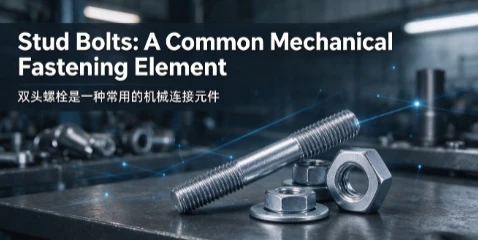
Stud bolt is a commonly used mechanical fastener, consisting of a screw rod with two nuts. Threads are machined on both ends of the stud bolt, and the middle shank is plain. It can connect two components with a large hole spacing.
Features:
Various materials: Stud bolts can be manufactured from carbon steel, stainless steel, copper and other materials to adapt to different service environments and working requirements.
Complete specifications: Stud bolts are available in a wide range of specifications to meet connection requirements of different dimensions and load strengths.
Easy installation: Threads are provided on both ends of the stud bolt. During assembly, pass the stud bolt through the components to be connected, then screw on nuts at both ends. Compared with ordinary bolts, it offers greater flexibility for assembly and adjustment.
Main applications: Stud bolts are widely used in machinery manufacturing, power equipment, electronic devices, construction works, bridges, automobiles, furniture and other fields. They fasten two or more components into a whole for connection and fixing.
Additional professional knowledge about stud bolts:
Manufacturing of stud bolts: The production process mainly includes forging, heat treatment and machining. Suitable raw materials are selected first, and blanks are formed by forging. Heat treatment is then carried out to adjust hardness and toughness and improve mechanical properties. Finally, threads on both ends are turned by machining.
Selection of stud bolts: When selecting stud bolts, apart from specification, material and surface treatment, the strength grade shall also be confirmed. The strength grade represents the load capacity of the stud bolt, commonly marked as Class 8.8, Class 10.9, etc. A higher grade number indicates higher tensile strength.
Installation of stud bolts: During installation, ensure matching between the stud bolt and the hole diameter of connected parts. Select a proper stud bolt length, neither too long nor too short. Apply torque evenly during tightening to avoid over-tightening. A torque wrench or torque power tool is recommended where possible to control the tightening torque.
Inspection and maintenance of stud bolts: Check the tightening condition of stud bolts regularly in service. Retighten them promptly once loosening is found. Clean dust and corrosion products on the surface periodically to extend service life.
In summary, the stud bolt is a simple yet highly practical fastener. Proper use and regular maintenance can ensure safe and stable operation of mechanical equipment.