
Failure Analysis Of High-Strength Bolt Fracture: Identify The Root Cause For Risk Mitigation
Nov 18, 2026
Sudden fracture of high-strength bolts frequently occurs at construction sites. Many purchasers and maintenance personnel immediately assume the product is defective. In fact, bolt fracture stems from a wide range of complex factors, including raw material, heat treatment, assembly and service environment. If the real root cause of failure is not identified and only new bolts are replaced, repeated fracture accidents are highly likely to happen. Today, Jiangsu Jinrui Metal Products Co., Ltd. discusses common fracture types, causes and corresponding prevention and control measures for high-strength bolts.
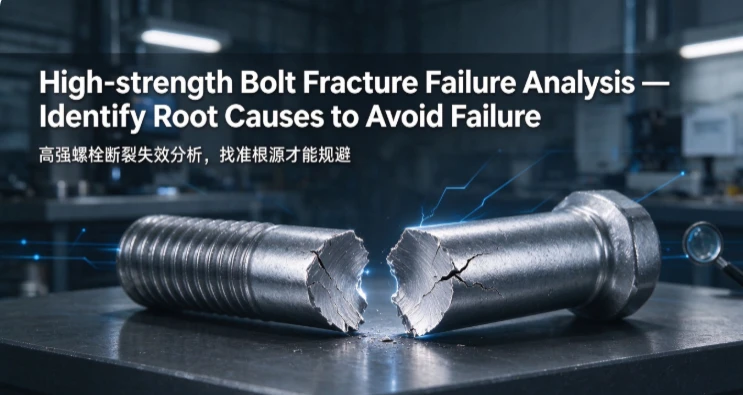
1. Hydrogen Embrittlement Fracture: The Most Hidden Risk of Delayed Fracture
Hydrogen embrittlement is a frequent and highly dangerous failure mode for high-strength bolts, commonly seen in Grade 10.9 and Grade 12.9 fasteners. Hydrogen atoms penetrate into steel during pickling, electroplating and other processes. These atoms accumulate at stress-concentrated zones and trigger delayed fracture under continuous preload.
Typical characteristics: The bolt performs normally during assembly, yet fractures hours, days or even weeks after installation. No obvious plastic deformation is observed, and the fracture surface is flat, indicating brittle fracture.
✅ Key point: The higher the strength grade, the more sensitive the bolt is to hydrogen embrittlement. Grade 12.9 high-strength bolts carry far higher hydrogen embrittlement risks from electroplating than Grade 8.8 bolts.
Prevention measures: Prioritize low-hydrogen processes; conduct timely baking for hydrogen removal after electroplating; for high-grade high-strength bolts, prefer low-hydrogen-absorption surface treatments such as black oxide coating and Dacromet coating.
2. Overload Fracture: Excessive Tightening Torque Exceeding the Material Yield Limit
Overload fracture mostly arises from assembly operations and is human-induced. To prevent loosening, construction workers blindly apply excessive torque, generating preload that exceeds the bolt's load-bearing capacity. The bolt undergoes plastic elongation and eventually snaps. Overload fracture features distinct tensile deformation and necking at the fracture surface.
A common misconception on site: higher torque means tighter fastening. In reality, high-strength bolts have a designed preload range, and excessive torque is a frequent human cause of bolt fracture.
Prevention measures: Tighten with torque wrenches in accordance with specified torque values; prohibit brute force tightening using extended sleeves; strictly follow matching torque standards for bolts of different sizes and grades.
3. Fatigue Fracture: Progressive Failure under Alternating Vibration Loads
Fatigue fracture tends to occur under continuous vibration conditions such as wind turbines, conveyor equipment and construction machinery. Subjected to repeated alternating loads over a long period, tiny cracks initiate at the thread root and stress notches. These cracks keep propagating and eventually lead to instantaneous fracture. Fatigue fracture usually emerges after long-term service and is hard to detect visually before failure.
✅ Key point: The thread root is a stress-concentration zone and the primary location for fatigue crack initiation.
Prevention measures: Optimize assembly to ensure uniform stress distribution; adopt matched anti-loosening solutions for heavily vibrated joints; carry out regular inspections and replace high-strength bolts that have reached their service life.
4. Fracture Induced by Heat Treatment Defects
Heat treatment is the core process that determines the mechanical performance of high-strength bolts. Poor process control will leave hidden fracture risks. Common defects include quenching cracks, coarse grain structure and insufficient tempering. Insufficient tempering results in excessive hardness, reduced toughness and brittleness, so the bolt may fracture under minor loads. Quenching cracks are inherent defects formed during heat treatment, which expand under stress and cause fracture later.
Prevention measures: Select suppliers with stable processes; require hardness and metallographic test reports delivered with finished products, and strictly control heat treatment parameters.
5. Stress Corrosion Cracking: Combined Effect of Corrosive Environment and Tensile Stress
In humid, salt-spray and corrosive environments, corrosive media continuously erode thread surfaces while the bolt bears tensile preload. The combined effect leads to stress corrosion cracking.
This failure is particularly prominent in coastal and chemical environments. Cracks mostly propagate along grain boundaries and belong to brittle cracking. Unlike ordinary rusting, it does not fail slowly by corrosion; instead, cracks expand rapidly and cause sudden fracture.
Prevention measures: Select suitable materials such as stainless steel and alloy fasteners for corrosive working conditions; apply corrosion-resistant coatings and implement environmental anti-corrosion protection.
6. Fracture Risks from Machining Defects and Improper Assembly
Rough thread machining, insufficient thread root radius and impact scratches all create stress notches. Scratches and dents generated during handling and assembly form stress concentration points and become crack initiation sites. Besides, uneven flange surfaces, skewed gaskets and debris on contact surfaces cause eccentric loading on bolts, introducing additional bending stress and greatly raising fracture probability.
✅ Key point: Eccentric loading (bending load) is far more destructive to high-strength bolts than pure axial tension.
Prevention measures: Ensure mating surfaces are flat and clean; avoid scratching threads during handling and assembly; machine threads with standard root radii to reduce stress concentration.
Summary
High-strength bolt fractures mainly fall into six categories: hydrogen embrittlement fracture, overload fracture, fatigue fracture, fracture from heat treatment defects, stress corrosion cracking and bending fracture triggered by stress notches.
To avoid failures, the core is to identify the fracture type and root cause first. Multi-dimensional control covering heat treatment, surface treatment, assembly torque, corrosion protection and contact surface flatness can fundamentally reduce fracture accidents of high-strength bolts.