
Performance Knowledge Of Bolt Connections
Aug 21, 2025
When connecting bolts or screws, it is necessary to pay attention to their basic characteristics, and then standardize the operation according to the different uses and performance of the bolts. This article mainly analyzes the basic knowledge and key points of bolt connection.

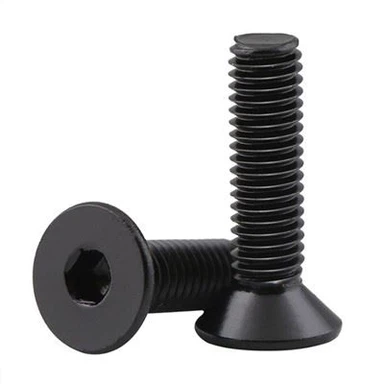
The internal and external hexagon bolts we use daily all belong to the connection method of ordinary bolts, and bolts of different materials are selected for installation completely according to the requirements of construction performance. For such ordinary bolts, a minimum tensile test can be conducted on the bolts before installation; as long as they meet the current national standard requirements, they can be used with confidence. After the installation of ordinary bolts is completed, it is optimal for the threads at the tail end to expose 2 threads-this represents the most reliable connection length and pretension state, suitable for equipment installation in the industrial field and assembly of small electrical appliances.
When installing on thin steel plates, self-tapping screws and blind rivet fasteners are used. The specifications and reserved hole diameters must be consistent. Since the installation is carried out on the large plane of the steel plate, the arrangement spacing of self-tapping screws and blind rivet fasteners needs to be neat and aesthetically pleasing, and in line with design requirements. Attention should be paid to the distance between the edge of the steel plate and the screw installation position: if it is too far from the edge, the firmness will be insufficient; if it is too close to the edge, the plate will easily be cracked when tightening.
A large number of steel structure bolts are used in bridge installation and construction. Due to the importance of bridges, sampling inspection must be conducted for each batch of bolts used, and a slip resistance coefficient test must be carried out on the friction surfaces (contact surfaces of structural parts) matched with the bolts on site. All results shall be enforced in accordance with national standards. It should be ensured that the material and production batch number of the bolts used are from the same batch. In addition to inspecting the smoothness of the bolts, it is also necessary to check whether the edges and orifices of the connecting steel plates have burrs or unevenness. After the bolts are installed, torque rechecking shall be conducted within 1 hour and 48 hours respectively, and the specific inspection key points shall be operated with reference to the provisions of GB 50205.
Torque rechecking of steel structure bolts is crucial. Industry associations have issued professional inspection procedures for the methods and standards of this inspection, which are divided into two types: torque method inspection and angle method inspection. A standard torque value is calculated according to a formula, and then a professional torque wrench is used for testing: if it is too tight, loosen it slightly; if it is too loose, tighten it slightly. In principle, it is necessary to ensure that the pretension torque value of each bolt is consistent. The simple process of torque rechecking is as follows: draw a line to mark the vertical corresponding position between the bolt tail and the nut, turn the nut back 60 degrees, and then use a torque wrench to screw the nut back to its original position. A deviation within 10% during this process is acceptable and considered qualified. Since the plane of the steel plate is not absolutely flat, after the bolt is tightened, the connection part between the bolt head and the steel plate may be uneven. Therefore, a certain tolerance range is allowed for the torque value of each bolt. The principle of the angle inspection method is similar to this.
Different from ordinary bolts, during the installation of steel structure bolts, the process of initial tightening, retightening, and final tightening must be followed (specifically, it shall be implemented in accordance with national standards based on bolt specifications and the importance of joints). Initial tightening, retightening, and final tightening are not unnecessary operations; instead, through this repeated tightening process, the bolt head can fit better with the steel plate, and the force on the bolt can be more uniform. The exposed threads of steel structure bolts, like ordinary bolts, are optimal with 2 threads exposed. In addition, gas welding and cutting must not be used to process the holes in the steel plate through which the bolts pass-holes made by gas welding and cutting are uneven in size and have excessive burrs around them, which will affect the load-bearing capacity of the effective cross-sectional area of the bolts and torque transmission during installation. Drilling or punching processes shall be adopted instead.