
Detailed Introduction To Surface Treatments For High‑Strength And Corrosion‑Resistant Bolts
Aug 26, 2026
The proper selection of surface treatment is critical in fastener design and selection. A wide variety of surface treatment processes are available for fasteners. Designers shall select economical and compatible solutions according to operating conditions, corrosion resistance requirements, assembly performance, temperature environment, environmental protection standards and cost budgets. Most commercial fasteners are made of carbon steel or alloy steel, which are susceptible to corrosion. Even fasteners manufactured from corrosion‑resistant materials require surface treatment to isolate corrosive media and delay oxidation.
Fastener coatings must feature strong adhesion, no peeling during assembly and disassembly, and appropriate thickness that does not interfere with thread engagement. In addition, the temperature resistance limit of most coatings is lower than that of the base steel material; therefore, service temperature must be considered during selection. Beyond appearance and anti‑corrosion functions, surface treatment greatly affects the fastening performance of fasteners, especially the consistency of torque‑preload force. Professional design comprehensively balances corrosion resistance, assembly manufacturability, operational stability and environmental compliance. This article introduces mainstream surface treatment processes for high‑strength and corrosion‑resistant fasteners.

1. Electro‑Galvanizing
Electro‑galvanizing is the most widely used coating for commercial fasteners. It is cost‑effective with neat appearance and available in multiple finishes including white zinc, yellow zinc, black zinc and olive drab. However, it offers relatively weak corrosion resistance among zinc‑based coatings. The neutral salt spray (NSS) life of conventional electro‑galvanizing is within 72 hours. With advanced sealing agents, the salt spray resistance can exceed 200 hours, but the cost is 5 to 8 times higher than ordinary galvanizing.
The electroplating process easily causes hydrogen embrittlement. Accordingly, high‑strength bolts of Grade 10.9 and above are generally prohibited from ordinary electro‑galvanizing. Although baking dehydrogenation is feasible, the passivation film will be damaged above 60 °C. Thus dehydrogenation must be performed after electroplating and before passivation, resulting in complicated operation and high cost. Most manufacturers do not conduct dehydrogenation unless specially required by customers.
Electro‑galvanized fasteners show poor and unstable torque‑preload consistency, so they are generally not used for critical structural connections. Lubricant coating after plating can be applied to improve torque stability and preload consistency.
2. Phosphating
Phosphating is cheaper than electro‑galvanizing but provides lower basic corrosion resistance. It must be oil‑sealed for effective protection. Ordinary anti‑rust oil provides only 10 to 20 hours of NSS resistance, while high‑grade anti‑rust oil can extend it to 72 to 96 hours at 2 to 3 times the cost.
Two mainstream phosphating types are applied to fasteners: zinc phosphating and manganese phosphating. Zinc phosphating offers excellent lubricity for precise assembly, while manganese phosphating provides superior corrosion resistance and wear resistance with an operating temperature range of 107 °C to 204 °C (225 °F to 400 °F).
The greatest advantage of phosphating is excellent torque‑preload consistency, ensuring stable and accurate assembly preload. It is widely used in critical industrial connections such as steel structure assemblies, engine connecting rod bolts, cylinder head bolts, main bearing fasteners, flywheel and wheel bolts. Furthermore, phosphating causes no hydrogen embrittlement, making it the standard surface treatment for Grade 10.9 and higher high‑strength bolts.
3. Oxide Bluing (Black Oxide Coating)
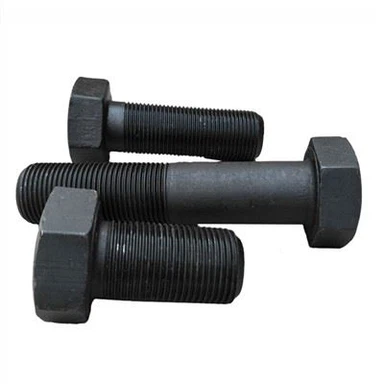
Bluing plus oil sealing is the lowest‑cost surface treatment for industrial fasteners with neat appearance, suitable for dry indoor environments. The black oxide film itself has almost no anti‑corrosion ability and fully relies on surface oil protection. Without oil, the surface rusts rapidly. The NSS resistance of oil‑sealed blued fasteners is only 3 to 5 hours.
Blued fasteners have poor torque‑preload consistency. Lubricating grease applied to thread surfaces before assembly can improve engagement quality and preload stability.
4. Cadmium Plating
Cadmium plating provides outstanding corrosion resistance, especially superior salt spray performance in marine environments compared with conventional treatments. However, its wastewater treatment is difficult and environmentally hazardous with extremely high production costs, approximately 15 to 20 times that of electro‑galvanizing. It is only adopted for extreme service conditions such as offshore drilling platforms and aerospace fasteners, and is rarely used in general industries. Cadmium plating also induces hydrogen embrittlement and is not suitable for ultra‑high‑strength bolts.
5. Chromium Plating
Chromium coatings are chemically stable in atmospheric environments with excellent gloss retention, high hardness and superior wear resistance. On fasteners, chromium plating is mostly used for decorative purposes. It is rarely used for heavy‑duty anti‑corrosion applications due to high cost comparable to stainless steel. It is only applied when stainless steel cannot meet strength requirements.
Chromium plating requires undercoats of copper and nickel to ensure adhesion and corrosion resistance. The coating can withstand high temperatures up to 650 °C (1200 °F), but hydrogen embrittlement remains a potential risk for high‑strength bolts.
6. Silver Plating & Nickel Plating
Silver plating provides both corrosion resistance and solid lubrication. It maintains stable performance at temperatures up to 870 °C (1600 °F) and effectively prevents thread oxidation and seizure under high‑temperature conditions. Due to cost constraints, it is mainly used for nuts and small precision bolts in high‑temperature equipment.
Nickel plating is primarily used for scenarios requiring both corrosion resistance and electrical conductivity, such as terminal fasteners for vehicle batteries.
7. Hot‑Dip Galvanizing (HDG)
Hot‑dip galvanizing is a high‑temperature thermal diffusion zinc coating with a thickness of 15 to 100 μm and excellent corrosion resistance, widely used for heavy outdoor engineering equipment. It suffers from poor thickness uniformity and severe environmental pollution caused by zinc residue and zinc vapor during production.
The thick coating often causes thread jamming and difficult engagement. Common solutions include tapping internal threads after galvanizing (which damages partial coating and reduces corrosion resistance) or pre‑enlarging nut thread holes by 0.16 to 0.75 mm (for M5–M30) before galvanizing (which slightly reduces structural strength). The Spiralock anti‑loosening thread design can solve this problem by accommodating thick coatings while maintaining full corrosion resistance and mechanical strength.
Due to high processing temperature altering the metallographic structure of heat‑treated bolts, hot‑dip galvanizing is prohibited for fasteners of Grade 10.9 and above.
8. Powder Zinc Diffusion
Powder zinc diffusion is a solid‑state metallurgical thermal diffusion process that forms uniform coatings on complex surfaces such as threads and blind holes. The coating thickness ranges from 10 to 110 μm with thickness error controlled within 10%. Among all zinc‑based treatments, it delivers the highest bonding strength and corrosion stability with zero pollution and no hydrogen embrittlement, ideal for high‑precision, high‑strength and high‑corrosion‑resistance fasteners.
9. Dacromet Coating
Dacromet (zinc‑chromium coating) features zero hydrogen embrittlement risk and excellent torque‑preload consistency. It provides superior salt spray resistance, high‑temperature stability and chemical corrosion resistance, and effectively prevents galvanic corrosion and oxidative embrittlement caused by dissimilar metal contact. Excluding hexavalent chromium environmental restrictions, it is one of the best surface treatments for high‑strength fasteners requiring extreme corrosion resistance.
Common Dacromet grades include 9028, G917 and G980, available in silver and black finishes. Grade 9028 is an economical formula for conventional corrosion protection; G917 offers excellent chemical resistance for complex media environments; G980 provides outstanding high‑temperature resistance for continuous service above 200 °C.
Complying with ELV, WEEE and RoHS environmental directives, Dacromet is widely applied in automotive, home appliance and construction industries. It is suitable for high‑temperature and heavily corrosive components such as automotive exhaust heat shields, radiators, chassis parts, gas meters and marine equipment.