

Comprehensive Analysis And Calculation Method Of Bolt Tensile Strength
Aug 25, 2026
1. Performance Grade Definition of Bolts and Studs
Bolts and studs are classified into ten mechanical performance grades: 3.6, 4.6, 4.8, 5.6, 5.8, 6.8, 8.8, 9.8, 10.9 and 12.9. The grade consists of two groups of digits separated by a decimal point. The digit before the decimal point represents one hundredth of the ultimate nominal tensile strength of the material; the digit after the decimal point represents ten times the ratio of the yield strength to the ultimate tensile strength of the material (yield ratio).
Nuts have seven performance grades ranging from Grade 4 to Grade 12. The grade number approximately represents one hundredth of the minimum guaranteed stress that the nut can withstand.
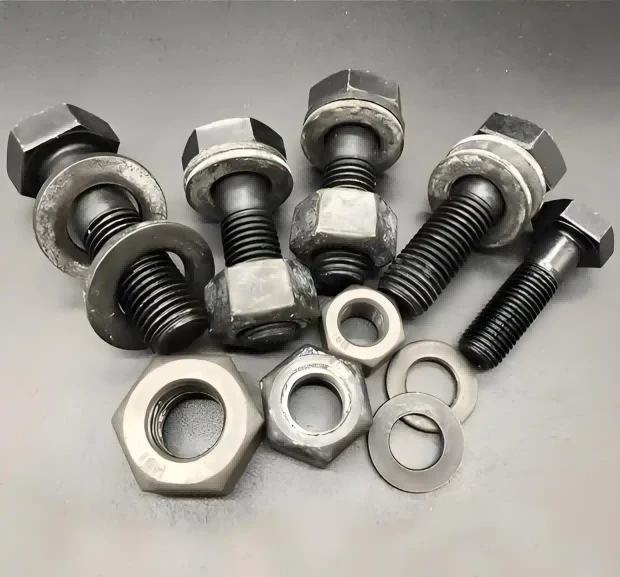
2. Classification of Thread Tolerance Grades
2.1 Unified Imperial Threads
All unified imperial threads adopt clearance fit. External threads have three tolerance grades: 1A, 2A and 3A; internal threads have three tolerance grades: 1B, 2B and 3B. A higher grade number indicates higher fitting precision, smaller clearance and tighter thread engagement.
Grades 1A and 1B: Loose tolerance grades, suitable for general free fitting of internal and external threads with high assembly tolerance.
Grades 2A and 2B: The universal standard tolerance grades for imperial mechanical fasteners, applicable to most conventional assembly conditions.
Grades 3A and 3B: The highest precision fitting grades with the tightest thread engagement, applied to high-precision, safety-critical and load-bearing structural designs.
2.2 Metric Threads
Common tolerance grades for metric external threads are 4h, 6h and 6g; common grades for metric internal threads are 5H, 6H and 7H. The preferred thread fit combinations in the industry are H/g, H/h and G/h. For precision fasteners such as bolts and nuts, the national standard recommends the 6H/6g fit to balance assembly accuracy and disassembly convenience.
3. Strength Grade Specifications for Carbon Steel and Stainless Steel Bolts
3.1 Carbon Steel Bolt Grade Interpretation
The strength grade mark of carbon steel bolts contains two sets of digits. The former represents the nominal tensile strength, and the latter represents the yield ratio. Taking Grade 4.8 bolt as an example: the digit "4" indicates a nominal tensile strength of 400 N/mm², and the digit "8" indicates a yield ratio of 0.8, with a nominal yield strength of 320 N/mm².
Structural bolts cover ten performance grades from 3.6 to 12.9. Bolts of Grade 8.8 and above are made of medium carbon steel or low-alloy steel and strengthened by quenching and tempering heat treatment, defined as high-strength bolts. Bolts below Grade 8.8 without enhanced heat treatment are defined as ordinary bolts.
Grade 4.6 bolt: nominal tensile strength of 400 MPa, yield ratio of 0.6, nominal yield strength of 240 MPa.
Grade 10.9 high-strength bolt: after heat treatment, the nominal tensile strength reaches 1000 MPa with a yield ratio of 0.9 and a nominal yield strength of 900 MPa.
3.2 Stainless Steel Bolt Grade Interpretation
The strength grade of stainless steel fasteners consists of two parts separated by a hyphen. The prefix before the hyphen indicates the material code, and the suffix after the hyphen indicates the strength grade. For example, A2-70 represents A2 austenitic stainless steel with a nominal tensile strength of 700 MPa.
4. Calculation Method of Bolt Tensile Strength
The tensile bearing capacity and tensile strength of bolts are calculated based on the effective stress cross-sectional area of threads rather than the nominal outer diameter, complying with GB/T 3098.1 and ISO 898-1 international standards.
Core Calculation Formula: F = Rm × As
Parameter Description: F refers to the ultimate tensile load of the bolt; Rm refers to the standard tensile strength of the bolt material; As refers to the effective stress cross-sectional area of the thread (fixed standard value, different from ordinary circular area).
To verify tensile strength under known load conditions: Rm = F / As. The calculation result shall be greater than or equal to the standard tensile strength of the corresponding grade to be qualified.
For simple estimation scenarios, the nominal cross-sectional area can be used temporarily: A=πd²/4 (d stands for the nominal bolt diameter). Standard effective thread stress area must be adopted for precise testing and engineering design to ensure accurate data.


