

Blackening Treatment Of Hexagon Socket Bolts And Solutions For Stripped Hexagon Socket Screws
Sep 16, 2026
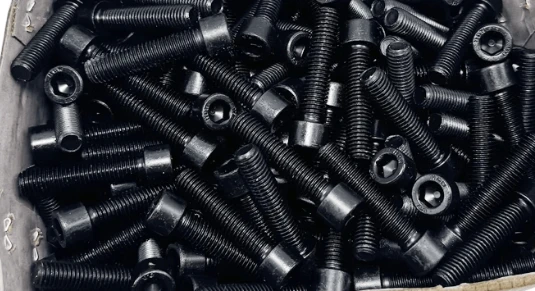
Hexagon socket bolts feature a unique forming process different from ordinary bolts and are widely used in mechanical assembly, steel structure supporting and equipment fastening scenarios. Blackening is a common surface treatment for high-strength hexagon socket bolts, generally applied to carbon steel bolts of Grade 8.8 and above. Through chemical reaction, a dense black oxide film is formed on the bolt surface, which mainly improves surface wear resistance and provides auxiliary anti-rust protection without changing the mechanical strength and compression resistance of the bolt substrate.
Blackening treatment, also known as bluing treatment, consists of multiple standardized procedures including degreasing, pickling and derusting, high-temperature oxidation, cleaning and oil sealing. A uniform black or blue-black oxide layer is finally formed on the steel surface. This process only affects the outer surface without altering the internal metallographic structure of the steel, which is fundamentally different from heat treatment processes such as quenching and tempering that modify substrate properties. The treatment is conducted at a moderate temperature with minimal risk of workpiece deformation, making it particularly suitable for high-precision and non-replaceable internal component assembly.
Blackened bolts are made of carbon steel. Compared with stainless steel fasteners, they offer obvious advantages including low cost, convenient processing and low deformation tendency. However, their anti-corrosion performance and decorative appearance are inferior to stainless steel. The black oxide film isolates air and achieves basic rust prevention with subsequent oil sealing. It is only applicable to indoor, dry and non-corrosive working environments with low appearance requirements, and is not suitable for outdoor humid, salt spray, acid and alkali corrosive conditions.
1. Solutions for Stripped Hexagon Socket Screws
Stripped hexagon socket screws are commonly caused by mismatched wrenches, insufficient wrench hardness, deflective force application and wear from repeated disassembly. Various repair and removal methods can be adopted according to different working conditions:
1. Vice Clamping Method: Suitable for screws with fully exposed heads. Secure the bolt head firmly with a vice to increase friction and rotate out the stripped screw steadily.
2. File Grooving Method: For screws with sufficient head margin, grind a straight slot on the screw head with a file, then tighten or remove the screw using a flat screwdriver.
3. Mini Electric Grinder Grooving Method: As an upgraded alternative to filing, a mini electric grinder accurately cuts a straight slot on the stripped screw head with smooth cuts and higher efficiency, ideal for repairing and removing precision screws.
4. Hacksaw Grooving Method: When professional tools are unavailable, cut a straight slot on the screw head with a fine hacksaw, then remove the stuck screw with a flat screwdriver.
5. Vibration Loosening Method: For tightly locked stripped screws, press a screwdriver firmly into the machined slot and tap the screwdriver tail gently with a hammer. The vibration releases thread locking stress for smooth removal.
6. Clamping Removal for Fully Exposed Screws: For long hexagon socket screws with sufficient exposed length, grip the screw head tightly with high-strength anti-slip pliers and unscrew steadily.
7. Destructive Removal for Concealed Screws: For hidden fasteners such as set screws and countersunk screws with no exposed structure and no room for grooving or clamping, grind off the screw head with an electric grinder, remove the assembled components, clean residual threads and replace with new screws.
2. Prevention Measures for Stripped Screws
Most stripped screw failures result from non-standard operation. During assembly, use precisely sized and high-hardness dedicated hexagon socket wrenches, maintain vertical and coaxial force application, and avoid deflective loading. This fundamentally reduces the wear and stripping risk of hexagonal socket holes.
Summary
Blackening treatment is a cost-effective surface process suitable for high-strength carbon steel hexagon socket bolts, featuring excellent wear resistance and zero substrate deformation risk, which is ideal for indoor precision assembly with limited anti-rust performance. Stripping of hexagon socket screws is a preventable and repairable common assembly issue. According to screw exposure conditions and locking status, non-destructive repair or destructive replacement can be flexibly adopted to improve maintenance and assembly efficiency, and ensure stable and reliable fastener connections.


