
Detailed Introduction To Property Classes Of Stainless Steel Bolts
Oct 23, 2026
Stainless steel bolts are externally threaded fasteners made of stainless steel. Their property class directly determines applicable working conditions and load-bearing capacity. Below is a detailed explanation of property classes for stainless steel bolts, for reference in material selection.
1. Meaning of Property Class Designations for Stainless Steel Fasteners
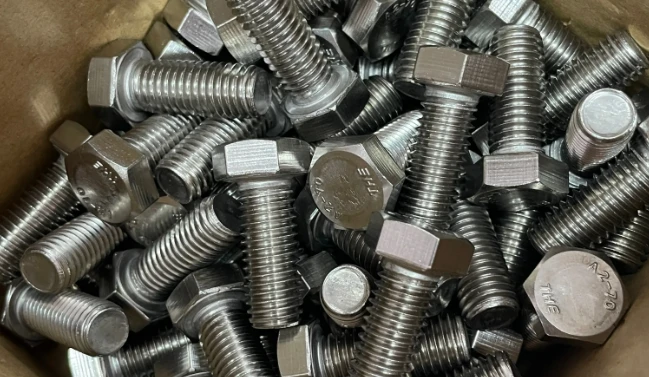
The property class system for stainless steel fasteners differs from the 8.8, 10.9 and 12.9 classes for carbon steel. It follows the designation format of material group code followed by strength grade number. Stainless steels are classified into austenitic, martensitic and ferritic groups according to microstructure, represented by codes such as A2, A4, C1 and C3. The number after the code denotes one tenth of the nominal tensile strength. For example, A2-70 stands for austenitic Group A2 stainless steel with a nominal tensile strength of no less than 700 MPa; A4-80 stands for austenitic Group A4 stainless steel with a nominal tensile strength of no less than 800 MPa.
2. Matching Property Classes of Stainless Steel Bolts, Studs and Nuts
The property classes for carbon steel bolts, screws and studs range from 3.6 to 12.9. In the designation, the integer before the decimal point represents one hundredth of the nominal tensile strength in MPa, while the number after the decimal point represents ten times the ratio of nominal yield strength to nominal tensile strength.
Common property classes for stainless steel bolts and studs include A2-50, A2-70, A2-80, A4-50, A4-70, A4-80, C1-50, C1-70, C3-80 and C4-70. Stainless steel nuts are designated with classes such as 025, 035, 051, 070 and 080. During selection, the nut strength class shall match the bolt property class to form a matched fastening assembly.
3. Property Classes of Stainless Steel Nuts
Stainless steel nuts are designated by strength class numbers, which roughly correspond to the nominal stress at the proof load. Common grades include A2-50 nuts, A2-70 nuts, A4-50 nuts, A4-70 nuts and A4-80 nuts. Nuts are used with stainless steel bolts of the same group and equal or one grade lower class, ensuring the threaded assembly avoids thread stripping, nut fracture and other failure modes under specified loads.
4. Thread Tolerance Classes for Stainless Steel Fasteners
1. Unified Inch Threads
For unified inch external threads, tolerance classes are 1A, 2A and 3A; internal threads are 1B, 2B and 3B. A higher class number indicates a tighter fit.
Classes 1A and 1B have the largest clearance and are suitable for external and internal threads with loose assembly clearance and wide tolerance fits.
Classes 2A and 2B are the most common thread tolerance classes for stainless steel mechanical fasteners in inch series, covering general assembly and standard working conditions.
Classes 3A and 3B provide the tightest fit, used for stainless steel standard parts with strict tolerance requirements and for joints in critical applications requiring high reliability.
2. Metric General Purpose Threads
Common tolerance classes for metric external threads include 4h, 6h and 6g; common internal thread classes include 5H, 6H and 7H. Standard recommended fits are H/g, H/h and G/h. For threaded joints of precision fasteners such as bolts and stainless steel nuts, the 6H/6g fit is generally preferred.
5. Distinction Between Property Class Markings for Carbon Steel and Stainless Steel
1. Carbon Steel Fasteners
The property class of carbon steel fasteners consists of two numbers separated by a decimal point, such as 4.8, 8.8, 10.9 and 12.9. The integer before the decimal point represents one hundredth of the nominal tensile strength; for example, the "4" in Class 4.8 denotes a nominal tensile strength of 400 MPa. The number after the decimal point represents the yield-to-tensile ratio, namely ten times the ratio of nominal yield strength to nominal tensile strength; for example, ".8" in Class 4.8 indicates a yield ratio of 0.8.
2. Stainless Steel Fasteners
The property class of stainless steel fasteners consists of a material group code and a strength number separated by a hyphen. The letter and number before the hyphen denote the stainless steel material group: A2 represents 300-series austenitic stainless steel and A4 represents 316-series austenitic stainless steel. The number after the hyphen denotes the strength grade, such as A2-70 and A4-80, corresponding to different nominal tensile strength requirements.
6. Summary
Property classes of stainless steel bolts, thread tolerance classes, as well as the markings for carbon steel and stainless steel fasteners are all conveyed through combined numbers and letter codes. Different codes correspond to distinct material groups, mechanical properties and thread fit precision. In engineering selection, the applicable material group, property class and thread tolerance shall be matched according to service environment, load magnitude, corrosion resistance requirement and assembly condition, so as to ensure joint quality and engineering safety.