
Basic Knowledge Of Fastener ProductsBasic Knowledge Of Fastener Products
Jan 16, 2025
Looking back on the past, Xiaorui found that some friends lacked some common sense knowledge and understanding of the basic knowledge of fastener products. Today, Xiaorui will take you to recall:
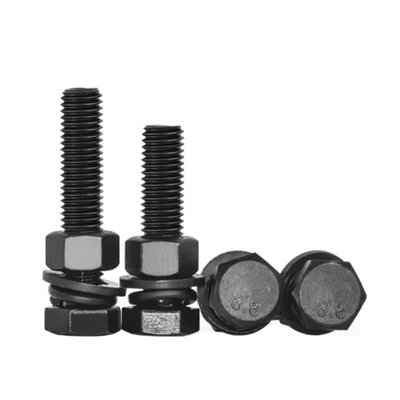
The standards for screws include: product name (standard), material, strength grade, specifications, and surface treatment
1. In terms of product types, the external hexagonal screws have a relatively larger torque capacity, the internal hexagonal screws have a smaller torque capacity, and the cross groove has a smaller torque capacity. In product matching use, we generally recommend using screws with a grade one level higher than nuts, which is the most cost-effective.
2. The product material grade mainly refers to the carbon steel commonly used in our Hongyi screws. According to the carbon content, we divide it into C1008 (corresponding to grade 4.8), C1035 (corresponding to grade 8.8), C1045 (corresponding to grade 10.9), SCM435 (corresponding to grade 12.9 and 45H), among which the higher the carbon content, the harder the material quality. Screws of grade 8.8 and above are considered high-strength screws.
3. For specifications such as M4x8, the outer diameter of the 4-finger tooth is 4mm, and the effective length of the 8-finger embedded in the loaded object is 8mm. Generally, countersunk screws are loaded with the total length, and semi countersunk screws need to add half the length of the head. And the cross head screw does not include the head size.
4. When the same material is subjected to heat treatment, the higher the hardness, the poorer the toughness. Electroplating of grade 8.8 or above requires heat treatment. There are currently two types of heat treatment we do: high-strength screws require quenching and tempering heat treatment, which means that the hardness of the screw is uniform from the inside out; Self tapping screws require carburizing heat treatment, which means that the surface of the screw is coated with a layer of carbon, which is very hard, but the inside is very soft. If carburizing is applied to the inside, the screw will be burnt.
5. In general, if the hardness is greater than 32HRC, there is a risk of hydrogen embrittlement during electroplating. Hydrogen embrittlement refers to the phenomenon where H+ions enter the metal and form bubbles during acid washing (oil stains) of the product. The screw remains in use for 24 hours before breaking. So, products with a risk of hydrogen embrittlement need to undergo hydrogen treatment after electroplating.