

What Consequences Does An Improper Preload Bring To Threaded Fastener Connections?
Nov 23, 2026
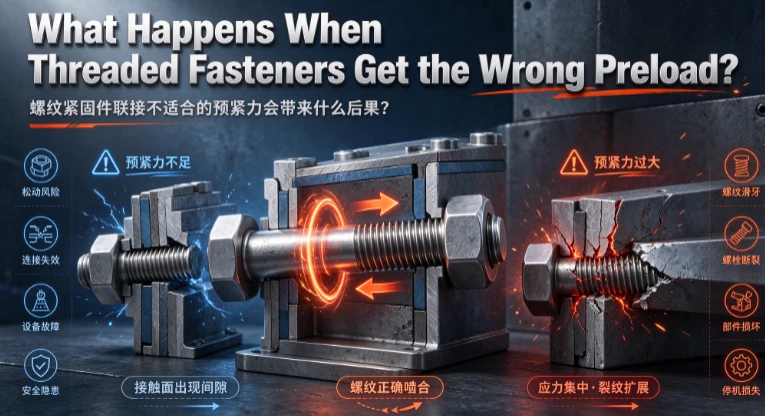
The preload of a threaded fastener connection is the force applied to the fastener before it bears the working load. Proper preload is an essential prerequisite for improving the reliability and tightness of the connection. If the preload falls below the required value, gaps or relative sliding may appear between the connected parts after loading, causing fastener loosening and even preventing the whole machine from operating normally. If the preload is excessive, it causes artificial component damage; for example, at O-ring sealing positions, excessive preload may crush the O-ring and lead to seal failure.
Improper preload in threaded fastener connections mainly brings the following consequences:
1. Static Fracture of Connected Parts
If threads are tightened excessively with too high preload, artificial component damage may occur: the bolt may twist off, connected parts may be crushed, seized, twisted or fractured, and thread profiles may be sheared off or stripped.
2. Slipping, Separation of Connected Parts or Fastener Loosening
For ordinary bolted joints carrying transverse loads, preload generates normal pressure between connected parts, and friction resists the external load. Therefore, preload level directly determines the load capacity of the joint. Insufficient preload causes the connected parts to slip, resulting in misalignment, skewing or wrinkling, and the bolt may even be sheared off.
For bolted joints under axial load, preload creates clamping force on the mating surface. After the external load is applied, the residual preload becomes the working clamping force on the mating surface. Insufficient preload leads to loosening of the mating surface and may even cause separation of the two connected parts. It also induces strong transverse vibration and causes nuts to back off.
3. Bolt Fatigue Failure
Improper preload leads to bolt fatigue failure in most cases. Reducing preload may lower the mean stress of the cyclic load on the bolt, but it increases the load amplitude; overall, it usually shortens the bolt's fatigue life and causes fatigue fracture. On the other hand, excessive preload keeps the bolt under high mean stress for a long time and reduces the fatigue margin, also posing a risk of fatigue fracture.
Therefore, the preload range must be reasonably determined in the assembly process. A scientific and reasonable pre-torque range should be worked out by comprehensively considering the importance of connected parts, loading conditions, movement mode, structural features, thread size and property class, material of connected parts and the purpose of the joint. The torque requirements specified in the process must be strictly followed during assembly. Only in this way can the reliability of threaded connections and the fatigue resistance of connected parts be truly improved.


