
Fastener Knowledge | Fastener Rotating And Non Rotating Loosening Analysis
Oct 20, 2022
The connection of threaded fasteners is widely used, and the problem that makes us headache is the looseness of threaded fasteners in the use process. To solve this problem, experts have been designing methods to prevent fasteners from loosening. There are many mechanisms that lead to the loosening of fasteners. Recently, Xiaorui learned some information and shared it with you. I hope it will help you.
Rotating and non rotating looseness
In most applications, threaded fasteners are tightened to apply preload in the joint. Looseness can be defined as the loss of preload after tightening. This can happen in either of two ways. Rotational loosening, usually called self loosening, refers to the relative rotation of fasteners under external load. Non rotational loosening means that there is no relative rotation between the internal thread and the external thread, but preload loss will occur.
Looseness of fasteners due to non rotating looseness
After assembly, deformation of the fastener itself or joint may cause non rotational loosening. This may be the result of partial plastic collapse of these interfaces. When two surfaces contact each other, the micro convex body on each surface bears the pressure load of the support surface. As the actual contact area of the bulge may be much smaller than the macro area, even under medium load, the stress of the bulge due to surface roughness will be greater than the yield strength of the material, and these bulges will bear very high local stress, resulting in plastic deformation.

This will cause the surface to partially collapse after the tightening operation. This collapse is often referred to as embedment. The magnitude of the clamping force lost due to embedding depends on the stiffness of the bolt and the connected part, the number of interfaces in the joint, the surface roughness and the applied contact stress. Under moderate surface stress conditions, the initial collapse usually results in a loss of clamping force of about 1% to 5%, half of which is lost in the first few seconds after the joint is tightened. When the joint is then dynamically loaded by the applied force, the joint will be further reduced due to the pressure changes that will occur on the joint interface.
Looseness due to insertion loss is problematic at joints consisting of several thin joint surfaces and small bolt clamping lengths. If the surface bearing stress remains below the compressive yield strength of the joint material, the embedded loss can be calculated and compensated by the joint design.
Junker Fastener Self loosening Theory

Gerhard Junker published a technical paper ("New Standard for Fastener Self loosening under Vibration" SAE paper 6900551969) in 1969, giving the results of the test work he completed to support his theory on the causes of thread fastener self loosening. His key finding was that once there was relative movement between the mating threads and between the bearing surface of the fastener and the clamping material, the pre fastener would become loose due to rotation. Junker found that the lateral dynamic load produces more serious self loosening conditions than the axial dynamic load. The reason is that the radial motion under axial load is obviously smaller than that under transverse load.

Junker's research shows that the pre tensioned fastener will loose itself when there is relative movement between the mating thread and the fastener bearing surface. This relative movement occurs when the lateral force acting on the joint is greater than the friction force generated by bolt pre tightening. For small lateral displacement, relative movement may occur between the thread side and the contact surface of the support area. Once the thread clearance is overcome, the bolt will be subjected to bending force, and if the lateral sliding continues, the bearing surface of the bolt head will also slide. Once this happens, the thread and bolt head will only have a small friction coefficient, or even temporarily lose friction. The rotation torque generated on the thread due to the pre tightening force acting on the screw angle of the thread, therefore, the relevant rotation will occur between the nut and the bolt.
Under repeated lateral movement, the mechanism can completely loosen the fastener. In order to study the causes of looseness, Juncker developed a testing machine, the so-called "Juncker machine", which will quantify the effectiveness of the looseness resistance of fastener design.

Roller bearings are used to eliminate the effects of friction between the moving and stationary plates. The pressure sensor allows continuous monitoring of the bolt load when lateral movement is applied from the moving plate clamped by the nut. This is a major advantage over the impact test standard because the preload loss can be measured during the test and the preload can be plotted against the cycle. The idea behind Junker machine is that the lateral displacement generated by the cam will cause the joint to swing (slip), and self loosening will occur after overcoming the friction of fasteners.

For Jinrui, whether you are a fastener demander/dealer/supplier, you can visit the official website of Jinrui for more information: https://www.jinruibolt.com/
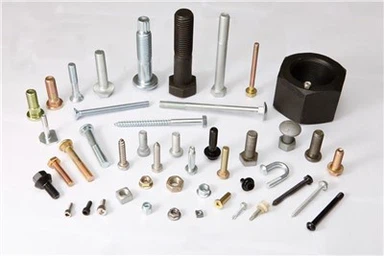
Part of Jinrui's product display
Jiangsu Jinrui Metal Products Co., Ltd. is the production base of Shanghai Jinrui standard parts. The factory covers an area of more than 20000 square meters, with a registered capital of 50 million yuan, a total investment of more than 100 million yuan, and an annual output of more than 20000 tons. Its products are exported to more than 40 countries.
Since its establishment in 2001, Jinrui Company has developed into a new layout with Hai'an in Jiangsu as its production base and Baoshan in Shanghai and Nanyang in Henan as its sales centers after more than 20 years of unremitting efforts.
At present, Jinrui's main products include the following six categories:
1. The main products of bolts include metric and American round head oval neck bolts (also called fishtail bolts), internal and external hexagon bolts, hexagon flange bolts, carriage bolts, wheel hub bolts, etc
2. Stud products: full thread thread, double head studs, etc
3. Nut products: hexagon nut, flange nut, heavy nut, square nut, butterfly nut, etc
4. Screw products: self tapping screws, self tapping self drilling screws, wood screws, various machine screws, etc
5. Washer products: flat washer, spring washer, square washer, lock washer, etc
6. Fastener related non-standard products
The wire drawing plant under Jinrui Company also provides processing services such as fine drawing, rough drawing and spheroidizing of wire rods, and supplies finished wire rods of various domestic famous steel mills.
Adhering to the business philosophy of "pioneering and innovating, pursuing excellence", Jinrui has successively introduced multiple types of heading and forming machines, thread rolling machines, nut machines, hot heading and rolling machines, lathes, large hot heading machines and their supporting testing equipment, such as magnetic particle flaw detectors, metallographic analyzers, salt spray testing machines, direct reading spectrometers and optical screening machines, tensile machines, Vickers hardness meters, Rockwell hardness meters, etc., and has set up independent research and development departments, It can produce all kinds of high-quality fasteners such as GB, DIN, ANSI, JIS and ISO international standards. The products are widely used in petroleum, chemical industry, boiler, wind power generation, highway guardrail board, elevator guide rail, machinery manufacturing, construction sites, auto parts, medical equipment and other fields.
Jinrui has been developing vigorously since its establishment. It integrates the advantages of each company, carefully designs and strictly selects materials to make the products more durable, and is highly praised by the majority of users. Jinrui won the ISO9001: 2000 international quality system certification in 2001, the special equipment manufacturing license in 2010, and the TS16949 automobile quality management system certification in 2012. The People's Insurance Company of China underwrites the "Global Product Liability Insurance" for its products, ensuring that every screw can be used with confidence, determination, and peace of mind!
Whether now or in the future, Jinrui will always adhere to the core service concept of "quality first, science and technology to revitalize enterprises, users first, and considerate service", sincerely provide you with high-quality services and high-quality products, and Jinrui will also become your most loyal long-term partner.