
Differences Between Flat Washers And Spring Washers
May 26, 2026
1. Flat Washers
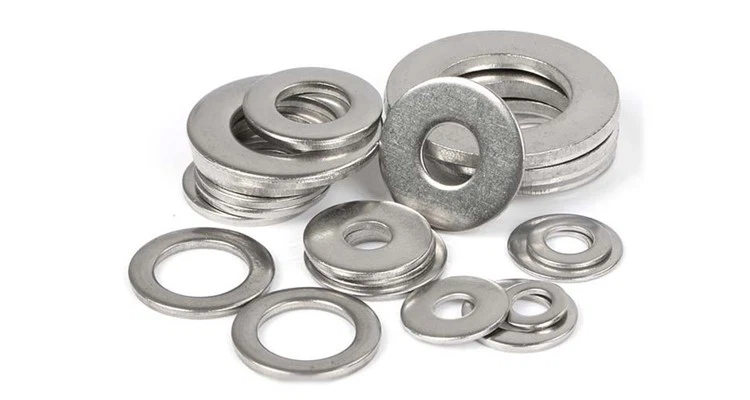
A flat washer is a basic fastener accessory commonly matched with bolts and nuts in various mechanical assembly scenarios. Its core functions are to increase the contact area, disperse compression pressure and protect the surface of workpieces. It has no anti-loosening or shockproof performance.
1.1 Core Characteristics and Usage Requirements
(1) It features excellent sealing performance and stability, resisting deformation and leakage under conventional temperature and pressure conditions, making it suitable for general fixed connection scenarios.
(2) It ensures uniform surface fitting and assembly flatness, avoiding uneven stress caused by bolt compression.
(3) It has good compression and wrinkle resistance, maintaining stable shape under pressure to prevent damage to workpieces and bolt structures.
(4) The material is stable with strong oxidation and pollution resistance, adaptable to various equipment assembly environments.
(5) It is easy to disassemble and reusable with high universality in assembly.
(6) It has stable temperature adaptability and can work steadily within the standard operating temperature range.
It is recommended to select flat washers with anti-rust and anti-corrosion treatments such as immersion coating and galvanizing, which can effectively extend service life and reduce later maintenance costs.
1.2 Selection Standards for Flat Washers
(1) Material matching: Avoid galvanic corrosion caused by contact of different metals. The washer material should be consistent with the connected parts. Common materials include carbon steel, alloy steel, stainless steel and aluminum alloy. Copper and copper alloy washers can be used for conductive occasions.
(2) Size selection: The inner diameter of the flat washer shall be selected according to the maximum diameter of the screw or thread. For soft connecting materials or assemblies matched with spring washers, flat washers with larger outer diameters are preferred to further disperse pressure.
(3) Structural adaptation: For bolts with rounded corners under the head, flat washers with inner hole chamfers shall be adopted to avoid assembly interference and poor fitting.
(4) Strength adaptation: Steel flat washers must be used for large-diameter bolts, important load-bearing connections and tension-shear composite connections to improve extrusion resistance and connection stability.
(5) Special working condition adaptation: Copper washers for conductive requirements and special sealing washers for airtight requirements shall be adopted to meet special application needs.
1.3 Main Functions of Flat Washers
(1) Increase the contact area between bolts, nuts and equipment workpieces, disperse compression stress and prevent workpiece damage caused by excessive local pressure.
(2) When matched with spring washers, it isolates spring washers from the workpiece surface to prevent surface scratching and wear during vibration and disassembly. The standard assembly sequence is: workpiece surface → flat washer → spring washer → nut.
(3) Fill assembly gaps and level the contact surface to improve the uniformity of bolt compression, serving as leveling and compensation washers.
1.4 Advantages and Disadvantages of Flat Washers
Advantages:
① Increase the stressed area to effectively protect the workpiece surface from extrusion deformation and damage;
② Disperse compression pressure, reduce local pressure on the equipment surface, and protect soft and brittle workpieces.
Disadvantages:
① No anti-loosening function, unable to prevent bolt loosening caused by equipment vibration;
② No shock absorption and buffering performance, not suitable for independent locking under high-frequency vibration conditions.
2. Spring Washers
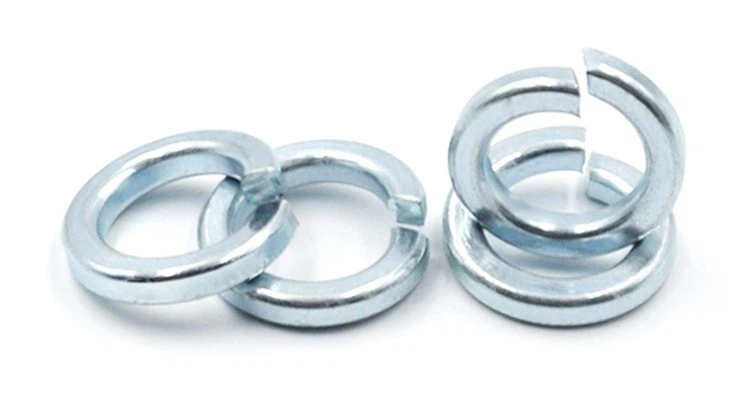
A spring washer is a common anti-loosening fastener accessory. It provides continuous jacking force through elastic deformation, which is mainly used for structural connections under vibration and dynamic load conditions to prevent loosening and falling off of bolts and nuts.
2.1 Core Functions of Spring Washers
(1) Anti-loosening locking: After the nut is tightened, the spring washer continuously jacks up the nut by elastic force, increases the friction between threads, offsets the loosening trend caused by equipment vibration and load fluctuation, and effectively prevents bolt loosening.
(2) Vibration buffering: Under vibrating working conditions, it absorbs part of the vibration impact force through elastic deformation, reduces thread wear and improves connection stability.
(3) Spring washers can be used independently under conventional working conditions. Flat washers shall be matched if workpiece surface protection and pressure dispersion are required.
2.2 Advantages and Disadvantages of Spring Washers
Advantages:
① Excellent anti-loosening effect, suitable for working conditions with vibration and dynamic loads;
② Good buffering and shock absorption performance, reducing thread wear;
③ Simple structure, low cost, convenient installation and strong universality.
Disadvantages:
The performance of spring washers is greatly affected by materials and heat treatment processes. Unqualified materials or improper quenching and tempering processes may easily cause cracking, elastic failure and collapse. It is necessary to select qualified products from regular manufacturers to avoid connection failure risks.
3. Core Differences Between Flat Washers and Spring Washers
1. Different functions: Flat washers are mainly used for workpiece protection, pressure dispersion and gap leveling; spring washers are mainly used for anti-loosening locking and vibration buffering.
2. Different properties: Flat washers are non-elastic with no anti-loosening ability; spring washers have elastic deformation capacity to provide continuous pre-tightening and anti-loosening effects.
3. Different application scenarios: Flat washers are preferred for static and vibration-free scenarios requiring workpiece surface protection; spring washers or combined assembly of flat and spring washers are required for scenarios with vibration, dynamic loads and anti-loosening demands.