
Definition, Materials And Performance Grades Of High-Strength Bolts
Aug 05, 2026
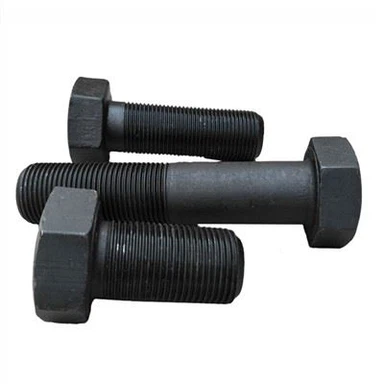
High-strength bolts are manufactured from high-strength alloy steel and capable of bearing large pre-tightening tension. They are widely used for critical connections in railway tracks, bridges, steel structures, high-pressure and ultra-high-pressure equipment. The fracture mode of high-strength bolts is mostly brittle fracture. In pressure vessels and high-pressure equipment, large standard-specified preload is generally applied to ensure overall sealing performance.

The connection of high-strength bolts relies on the friction between the contact surfaces of connected components to prevent relative sliding. To provide sufficient anti-sliding friction force, it is necessary to increase bolt pre-tension, enhance component clamping force and properly raise the friction coefficient of contact surfaces. The clamping force between components is completely provided by bolt pre-tension. Therefore, high-strength steel must be adopted for bolt manufacturing, which defines the essential characteristics of high-strength bolt connections.
The friction coefficient greatly affects the bearing capacity of high-strength bolt connections. It is mainly determined by the contact surface condition and substrate material of connected parts. In construction, contact surfaces are usually treated by sandblasting and steel wire brushing to remove oxide scales, oil stains and impurities, so as to increase the friction coefficient and ensure connection stability.
1. Common Materials and Performance Characteristics of High‑Strength Bolts
The tensile strength, hardness and comprehensive mechanical properties of high-strength bolts depend on substrate materials and quenching & tempering heat treatment processes. Conventional quenched 40Cr steel hardly meets the material performance requirements for Grade 10.9 high-strength bolts under stable conditions. In routine inspections, the tensile strength can be preliminarily judged by surface hardness after heat treatment. Bolts made of different materials differ obviously in delayed fracture performance and fatigue performance under high-stress conditions.
40Cr high-strength bolts are mostly applied in bolt ball joint grid structures with relatively controllable design bearing capacity. The design strength is approximately 390 MPa for bolts with diameter ≥ 30 mm and 430 MPa for bolts with diameter < 30 mm, with low pre-tension stress under normal working conditions. Strict verification of delayed fracture resistance is required if used in severe working conditions with high preload and high stress. Overall, 20MnTiB material presents better delayed fracture resistance than 40Cr and 40B.
In accordance with GB/T 1231, the recommended materials for Grade 10.9S large hexagon high-strength bolts are 20MnTiB for specifications ≤ M24 and 35VB for specifications ≤ M30. Large-diameter high-strength bolts are difficult to achieve full quenching penetration, resulting in unqualified core strength. Therefore, oversized high-strength bolts should be avoided in engineering applications. If necessary, the design working stress shall be reduced to ensure safety margin.
Anchor bolts and special-shaped bolts (including GB799 standard anchor bolts and L-type bolts) cover a specification range of M6–M120 with unlimited length. Common materials include Q235, 45# steel, Q345B, 40Cr and 35CrMoA. Structural types consist of straight hook, arc hook, anchor claw and stiffened anchor plate styles. Among them, 40Cr and 35CrMoA are dedicated high-strength materials for heavy-duty anchoring of equipment foundations and steel structures.
2. Matching Materials and Implementation Standards for Torshear Type High‑Strength Bolts
For Grade 10.9 torshear type high-strength bolts for steel structures (friction-type connection with a standard friction coefficient of 0.45), the matching materials are specified as follows: bolt material: 20MnTiB; nut material: 15MnVB. This fastener assembly complies with the national standard GB/T 3632-2008 Torshear Type High Strength Bolt, Nut and Washer Assemblies for Steel Structures, which shall be followed in procurement, inspection and construction.
3. Classification and Criteria of Bolt Performance Grades
The mechanical properties of carbon steel and alloy steel bolts, screws and studs are classified into ten standard grades: 3.6, 4.6, 4.8, 5.6, 5.8, 6.8, 8.8, 9.8, 10.9 and 12.9. The applicable thread diameter ranges from 1.6 mm to 39 mm with a normal operating temperature of -50℃ to 300℃. The working temperature of free-cutting steel fasteners shall not exceed 250℃.
Unified industry classification: Bolts of Grade 8.8 and above are made of medium carbon steel or low-alloy steel through quenching and tempering heat treatment, defined as high-strength bolts; bolts below Grade 8.8 are defined as ordinary bolts.
Each bolt performance grade consists of two figures, representing the nominal tensile strength grade and yield ratio respectively. This is an internationally universal standard. Bolts of the same grade deliver equivalent mechanical properties regardless of material and origin, so only the performance grade is adopted for design selection.
Example 1: Grade 4.6 ordinary bolt
1. Nominal tensile strength: 400 MPa;
2. Yield ratio: 0.6;
3. Nominal yield strength: 400 MPa × 0.6 = 240 MPa.
Example 2: Grade 10.9 high-strength bolt (after heat treatment)
1. Nominal tensile strength: 1000 MPa;
2. Yield ratio: 0.9;
3. Nominal yield strength: 1000 MPa × 0.9 = 900 MPa.