
Analysis Of Bolt Materials
Oct 29, 2026
Bolts are connecting fasteners classified by mechanical property class into ordinary bolts and high-strength bolts. Different materials directly affect the mechanical performance and applicable range of bolts. Below is an analysis of commonly used bolt materials for selection reference.
1. Common Materials for Ordinary Bolts
Bolts below Property Class 8.8 are ordinary-strength bolts, generally made from low-carbon or medium-carbon steel wire rod by cold heading and thread rolling, without quenching and tempering heat treatment. Taking the most commonly used Class 4.8 as an example: the nominal tensile strength is not less than 400 MPa, the yield-to-tensile ratio is 0.8, and the nominal yield strength is not less than 400 × 0.8 = 320 MPa.
Common wire rod grades for ordinary bolts include:
1008K
1010
1015K
1032
1035
1040
CH38F
1039
Other carbon steel wire rods meeting performance requirements
The above carbon steel wire rods are inherently non-magnetic-free; non-magnetic characteristics mainly apply to stainless steel fasteners. After cold working, austenitic stainless steels develop weak magnetism: 304M after cold working has a magnetism of approximately 1.6 μ to 2.0 μ, 304HC approximately 1.01 μ to 1.6 μ, and Grade 316 after cold working has magnetism below 1.01 μ.
2. Common Materials for High-Strength Bolts
High-strength bolts require materials with higher tensile strength to meet greater preload and load-bearing demands. Quenching and tempering heat treatment has a significant impact on material strength. After tempering, 40Cr generally cannot stably satisfy the material requirements of Class 10.9S structural high-strength bolts; under limited inspection conditions, surface hardness after tempering can be used as a preliminary reference for material strength grade. Under high stress, high-strength bolts made of different materials exhibit different delayed fracture resistance.
2.1 40Cr High-Strength Bolts
40Cr high-strength bolts are mainly used in bolt-ball joint space trusses. Their design strength is generally 390 MPa (d ≥ 30 mm) or 430 MPa (d < 30 mm), with relatively low pre-tensile stress under normal service. When applied to conditions requiring high preload, the delayed fracture resistance of the material must be carefully evaluated and ensured.
2.2 20MnTiB High-Strength Bolts
20MnTiB is a low-carbon boron-alloy steel. After quenching and tempering, it delivers well-balanced comprehensive properties, and its delayed fracture resistance is superior to that of 40Cr and 40B, making it suitable for high-preload, high-stress steel structure connection assemblies.
2.3 Standard-Recommended Material Selection
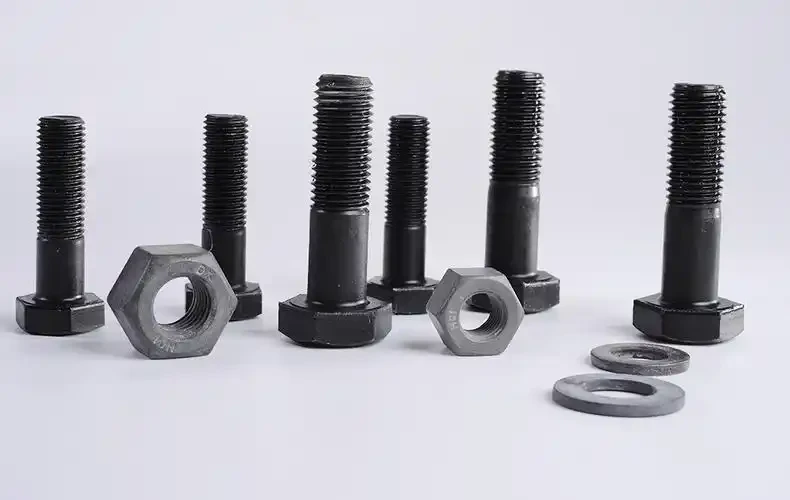
According to the current Chinese national standard for high-strength large hexagon head bolt, nut and washer assemblies for steel structures, recommended materials for Class 10.9S bolts are as follows:
Size ≤ M24: 20MnTiB;
Size M27–M30: 35VB.
Large-diameter high-strength bolts are difficult to through-harden during tempering, so excessively large diameters should be avoided. If large-diameter bolts are required, the working stress shall be reduced accordingly, and material hardenability must be verified to meet cross-section performance requirements.
3. Summary
For both ordinary bolts and high-strength bolts, material selection directly affects strength, toughness, fatigue resistance, delayed fracture resistance and applicable service range. During selection, matching material grades and heat treatment processes shall be chosen in accordance with load class, preload requirements, service environment and relevant standards to ensure joint reliability.