

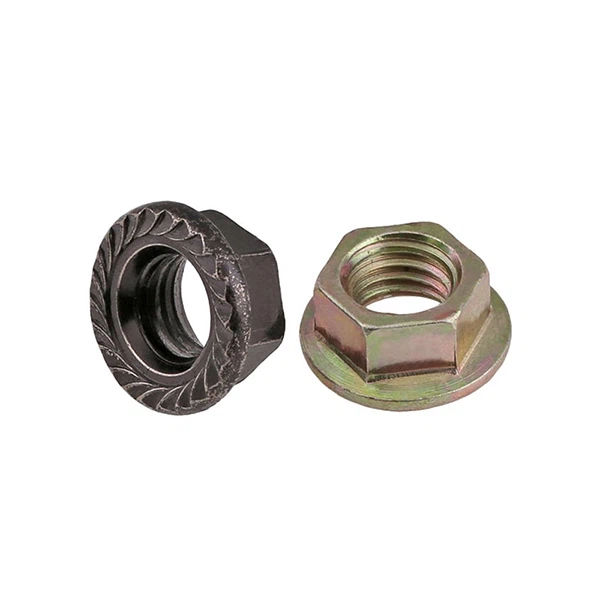
Hex Flange Nut also known as flanged hex nut, is a specialized type of fastener designed to provide a reliable and secure connection in various applications. This nut features a hexagonal shape, providing convenient use with a standard wrench or socket tool for tightening and loosening. What distinguishes the Hex Flange Nut is the incorporation of a flange, a flat, circular extension at one end of the nut.The flange serves a dual purpose in enhancing the nut's functionality. Firstly, it acts as a built-in washer, distributing the load and reducing the risk of surface damage or deformation. This proves particularly advantageous in applications where the nut is subjected to high levels of vibration or torque. The flange helps to maintain a uniform pressure distribution, contributing to the overall stability and durability of the fastened joint.Secondly, the flange facilitates easier assembly by providing a larger surface area for gripping during installation. This design feature is particularly beneficial in situations where manual dexterity may be limited, or when working in confined spaces.
Advantages of Hex Flange Nut
ncreased stability
Hex flange nuts are designed with a flange, or a wide circular base, which provides greater stability when fastened. This feature helps prevent loosening due to vibrations or external forces, ensuring a more secure and stable connection.
Enhanced load distribution
The flange on the nut provides a larger surface area for load distribution. This helps reduce the pressure on the connected material, preventing damage and ensuring a more even distribution of forces across the joint.
Resistance to rotation
Hex flange nuts resist rotation better than standard hex nuts due to their flange design. This makes them particularly useful in applications where preventing rotation is crucial for the integrity of the connection.
Sealing properties
Some hex flange nuts are designed with a built-in washer under the flange, providing a sealing function. This can help protect the joint from environmental factors such as moisture and dust, extending the lifespan of the connection.
-
![Hex Flange Nuts]() Add to Inquiry
Add to Inquiry -
![Galvanized Flange Nut]() Add to Inquiry
Add to Inquiry -
![Grade 8 Flange Nut]() Add to Inquiry
Add to Inquiry


Why Choose Us
High quality
Our products are manufactured or executed to a very high standard, using the finest materials and manufacturing processes.
24H online service
We try and respond to all concerns within 24 hours and our teams are always at your disposal in case of any emergencies.
Professional team
Our professional team collaborates and communicates effectively with each other, and is dedicated to delivering high quality results. We are capable of handling complex challenges and projects that require our specialized expertise and experience.
Advanced equipment
A machine, tool or instrument designed with advanced technology and functionality to perform highly specific tasks with greater precision, efficiency and reliability.
What Materials Are Typically Used to Make Hex Flange Nuts
Hex flange nuts are manufactured using a variety of materials, each chosen based on the specific requirements of the application. The choice of material depends on factors such as the environment in which the nut will be used, the required strength, corrosion resistance, and cost considerations. Common materials used for hex flange nuts include:
Carbon Steel: Carbon steel is a widely used material for hex flange nuts. It offers good strength and durability at a relatively low cost. However, carbon steel is susceptible to corrosion, so it may be coated with zinc or other protective finishes to enhance its resistance to rust.
Stainless Steel: Stainless steel hex flange nuts are popular for applications requiring corrosion resistance. Stainless steel alloys, such as 304 or 316, provide excellent resistance to rust and corrosion, making them suitable for use in challenging environments, such as marine or outdoor applications.
Alloy Steel: Alloy steel hex flange nuts are alloyed with elements such as chromium, molybdenum, or vanadium to enhance their mechanical properties, including strength and hardness. Alloy steel is often heat-treated to achieve specific levels of hardness and performance.
Brass: Brass hex flange nuts are known for their corrosion resistance, especially in environments with high humidity. They are also valued for their attractive appearance. However, brass is generally softer than steel, so it may not be suitable for high-strength applications.
Aluminum: Aluminum hex flange nuts are lightweight and resistant to corrosion. They find application in situations where weight is a critical factor, and they are commonly used in aerospace and automotive industries. However, aluminum has lower strength compared to steel.
Nylon: Nylon hex flange nuts are non-metallic and known for their lightweight and corrosion resistance. They are often used in applications where electrical insulation is required or where metal nuts may interact with sensitive materials.
How Do You Measure the Size of a Hex Flange Nut
The size of a hex flange nut is typically measured based on the diameter and thread pitch. Here's how you can measure the size of a hex flange nut:
Diameter
Measure the distance across the flat sides of the hexagonal shape. This is commonly referred to as the "across the flats" measurement.
For metric hex flange nuts, you'll measure the distance in millimeters.
For imperial (inch) hex flange nuts, you'll measure the distance in inches.
The diameter is a critical factor in determining the compatibility with the corresponding bolt or screw.
Thread pitch
The thread pitch is the distance between adjacent threads on the screw or bolt.
Metric hex flange nuts will have a metric thread pitch measured in millimeters (e.g., M6 x 1.0 means a 1.0mm pitch).
Imperial hex flange nuts will have an inch-based thread pitch (e.g., 1/4"-20 means 20 threads per inch).
It's important to note that hex flange nuts are typically labeled with a size designation that includes both the diameter and the thread pitch. For example, an M8 x 1.25 hex flange nut has an 8mm diameter and a 1.25mm thread pitch.
When measuring or selecting hex flange nuts, it's crucial to ensure compatibility with the corresponding bolt or screw. Using the wrong size can compromise the integrity of the fastening system. If you have the manufacturer's specifications or packaging, you can find the size information there.
What Is the Impact of Temperature on the Performance of Hex Flange Nuts
The performance of hex flange nuts can be influenced by temperature, and it's important to consider the potential impact of temperature variations, especially in applications where extreme temperatures are encountered. Here are some key factors to consider:
Material properties
The material of the hex flange nut can have specific temperature-related characteristics. For example, different metals and alloys expand and contract at different rates with changes in temperature.
Extreme temperatures can affect the hardness, strength, and ductility of materials. For instance, high temperatures may lead to reduced strength and increased susceptibility to deformation.
Thermal expansion and contraction
Temperature changes can cause thermal expansion or contraction of the materials used in hex flange nuts. This can lead to changes in the dimensions of the nut.
In applications where precise tolerances are crucial, thermal expansion should be considered to prevent issues such as loosening or tightening of fasteners due to temperature variations.
Corrosion resistance
Temperature variations can affect the corrosion resistance of the material. In some environments, elevated temperatures might accelerate corrosion processes.
For applications in high-temperature or corrosive environments, it's important to choose hex flange nuts made from materials with appropriate corrosion resistance properties.
Sealing and lubrication
Extreme temperatures may affect the performance of any sealing or lubricating elements present in the hex flange nut. Seals and lubricants may degrade or lose effectiveness under certain temperature conditions.
Consider using specialized high-temperature lubricants or seals if the application involves temperature extremes.
Thermal cycling
Rapid and repeated temperature changes, known as thermal cycling, can place additional stress on materials and fasteners. This stress can contribute to fatigue and potential failure over time.
In applications with significant thermal cycling, it's essential to choose materials and designs that can withstand the associated mechanical stresses.
What Are the Most Common Applications of Hex Flange Nuts
Machinery and equipment
Various types of machinery and equipment, ranging from small appliances to large industrial machines, incorporate hex flange nuts. They play a role in securing components, facilitating assembly, and providing stability in high-vibration environments.
Electronics and electrical equipment
Hex flange nuts are used in the assembly of electronics and electrical equipment. Their compact design and ease of use with standard tools make them suitable for applications in circuit boards, control panels, and electrical enclosures.
Aerospace industry
In aerospace applications, hex flange nuts are chosen for their reliability and ability to withstand high-stress conditions. They may be used in the assembly of aircraft components, satellite systems, and other aerospace structures.
Railway systems
Hex flange nuts are employed in the construction and maintenance of railway systems. They are used to secure rails, fastenings, and other components in tracks and infrastructure.
Automotive industry
Hex flange nuts are widely used in automotive manufacturing and repair. They are often employed in critical components such as engine assemblies, exhaust systems, chassis components, and wheel assemblies.
Construction and building
In the construction industry, hex flange nuts are utilized for fastening structural components, steel beams, and other critical elements. Their resistance to vibration makes them suitable for applications in buildings and infrastructure where stability is crucial.
Marine and shipbuilding
The marine industry relies on hex flange nuts for securing components in ship and boat construction. Their resistance to corrosion is particularly valuable in marine environments where exposure to saltwater and harsh weather conditions is common.
Oil and gas industry
The oil and gas sector often employs hex flange nuts in the assembly and maintenance of equipment such as pipelines, drilling rigs, and extraction machinery. Their durability and resistance to corrosion make them suitable for challenging environments.
How Do You Identify a High-Quality Hex Flange Nut
Identifying a high-quality hex flange nut involves assessing several key characteristics related to materials, manufacturing processes, and overall design. Here are some factors to consider when determining the quality of a hex flange nut:
Steel Grade: High-quality hex flange nuts are often made from materials with specified steel grades, such as stainless steel (e.g., 304 or 316), carbon steel, or alloy steel. Ensure that the material meets the required strength and corrosion resistance standards for the intended application.
Coating: Look for nuts with appropriate coatings, such as zinc plating or other corrosion-resistant finishes. A well-applied coating helps protect the nut from environmental factors and extends its lifespan.
Thread Quality: Check for well-formed, clean, and uniform threads. Inconsistent or poorly formed threads can lead to difficulties during installation and compromise the overall integrity of the connection.
Flange Dimensions: Ensure that the flange has consistent dimensions, providing a stable and secure base for the nut.
Precision Manufacturing: High-quality hex flange nuts are manufactured with tight tolerances, ensuring that each unit meets specified dimensions. Precision manufacturing is crucial for proper fit and function in various applications.
Grade Markings: Some hex flange nuts are marked with indicators of their grade or class. Look for clear and accurate markings indicating the grade of the material and any relevant standards compliance.
Strength Ratings: Understand the required strength for your application and ensure that the hex flange nut meets or exceeds those requirements. This may involve checking the nut's specifications for tensile strength, hardness, and other mechanical properties.
Prevailing Torque: Some high-quality hex flange nuts have prevailing torque features, such as nylon inserts or serrations, to prevent loosening due to vibration. Check for these additional features if resistance to rotation is crucial for your application.
How Do You Prevent Corrosion in Hex Flange Nuts


Material selection
Choose hex flange nuts made from corrosion-resistant materials such as stainless steel, brass, or other alloys with high resistance to rust and corrosion.
Consider the specific environmental conditions of the application and select a material that is suitable for exposure to moisture, chemicals, or other corrosive agents.
Coating and plating
Apply corrosion-resistant coatings or platings to the hex flange nuts. Common coatings include zinc plating, hot-dip galvanizing, or various types of polymer coatings.
These coatings provide a protective barrier against moisture and corrosive elements, enhancing the nut's resistance to corrosion.
Use protective sealants
Apply sealants or adhesives designed to protect against corrosion. These substances create a barrier that prevents moisture and contaminants from reaching the metal surface.
Choose sealants compatible with the materials in both the hex flange nuts and the fastened components.
Regular maintenance
Implement a regular maintenance schedule to inspect and clean hex flange nuts in corrosive environments.
Remove any accumulated debris, salts, or other corrosive substances, and replace nuts if signs of corrosion are detected.
Isolation and insulation
Use insulating materials, such as plastic or rubber washers, between the hex flange nut and the fastened components. This can help create a barrier that reduces direct contact between the nut and potentially corrosive surfaces.
Avoid dissimilar metal contact
Minimize or eliminate contact between dissimilar metals to prevent galvanic corrosion. Galvanic corrosion occurs when two different metals come into electrical contact in the presence of an electrolyte (such as moisture).
Proper storage
Store hex flange nuts in a dry and controlled environment to prevent exposure to humidity and moisture.
Use proper packaging or storage methods to protect the nuts from environmental elements during transportation and storage.
Environmental considerations
Be mindful of the specific environmental conditions in which the hex flange nuts will be used. For example, coastal or marine environments may require extra corrosion-resistant measures due to the presence of saltwater.
Application of anti-corrosive compounds
Apply anti-corrosive compounds or rust inhibitors to the hex flange nuts. These compounds create a protective layer on the metal surface, preventing corrosion.
Design considerations
Consider the design of the application and the placement of hex flange nuts. Ensuring proper drainage and ventilation can help reduce the likelihood of moisture accumulation.
How Do You Lubricate a Hex Flange Nut Before Installation
Select corrosion-resistant materials
Choose hex flange nuts made from materials with high corrosion resistance. Stainless steel, brass, and certain coatings (such as zinc plating or galvanizing) can provide protection against corrosion.
Apply corrosion inhibitors
Use corrosion inhibitors or protective coatings specifically designed for fasteners. These coatings create a barrier that shields the hex flange nut from corrosive elements.
Use nylon-insert lock nuts
Consider using hex flange nuts with nylon-insert lock features. The nylon insert not only provides a locking function but also acts as a barrier against moisture, reducing the risk of corrosion.
Apply anti-seize lubricants
Apply anti-seize lubricants to the threads of the hex flange nut before installation. These lubricants create a protective barrier, reducing friction and preventing the nut from seizing or corroding over time.
Maintain proper tightening torque
Ensure that the hex flange nuts are tightened to the recommended torque specifications. Over-tightening can lead to deformation of the nut or damage to the protective coatings, increasing the risk of corrosion.
Install washers
Consider using washers in conjunction with hex flange nuts. Washers can provide an additional layer of protection and help distribute the load evenly, reducing the risk of corrosion at contact points.
Regular inspection and maintenance
Periodically inspect hex flange nuts for signs of corrosion or wear. If corrosion is detected, clean the affected areas and reapply corrosion inhibitors or lubricants as needed.
Avoid mixing metals
Avoid mixing different metals in fastening applications, as this can lead to galvanic corrosion. When different metals come into contact, an electrolytic reaction can occur, accelerating corrosion. Stick to compatible materials in your fastening system.
Protective coatings and finishes
Consider using hex flange nuts with additional protective coatings or finishes, such as zinc-nickel plating, which enhances corrosion resistance. Consult with manufacturers to choose the most suitable coating for your specific application.
Store nuts properly
Store hex flange nuts in a dry and controlled environment to prevent exposure to moisture. If nuts are stored outdoors, use appropriate covers or containers to shield them from the elements.
How Do You Test the Strength of a Hex Flange Nut
Testing the strength of a hex flange nut typically involves subjecting it to various forces and conditions to evaluate its performance under different scenarios. Here are some common methods used to test the strength of hex flange nuts:
Tensile testing
Tensile testing involves applying a gradually increasing axial load to the hex flange nut until it reaches its breaking point. This test measures the maximum tensile strength and elongation before failure. Results help assess the nut's ability to withstand axial forces.
Proof load testing
Proof load testing involves applying a specified static load to the hex flange nut for a set period. The nut should not deform or fracture during this test. The applied load is typically a percentage of the nut's ultimate tensile strength.
Torque-tension testing
Torque-tension testing evaluates the relationship between the tightening torque and the axial tension force developed in the hex flange nut. This test helps ensure proper clamping force and assesses the nut's ability to maintain tightness under load.
Impact testing
Impact testing assesses the resilience of a hex flange nut by subjecting it to sudden, high-impact forces. This helps evaluate the nut's resistance to shock and dynamic loading.
Vibration testing
Vibration testing simulates the effects of continuous vibrations on the hex flange nut. This test assesses the nut's ability to maintain tightness and resist loosening under vibrational forces, which is crucial in applications prone to vibrations.
Environmental testing
Exposure to harsh environmental conditions, such as extreme temperatures, humidity, or corrosive substances, can affect the strength of hex flange nuts. Environmental testing evaluates how well the nuts withstand these conditions over time.
Fatigue testing
Fatigue testing involves subjecting the hex flange nut to repeated loading and unloading cycles. This test helps determine the nut's endurance and resistance to failure under cyclic stress conditions.
Shear testing
Shear testing assesses the hex flange nut's resistance to forces applied perpendicular to its axis. This is relevant in applications where shear forces are a primary concern.
Thread engagement testing
Thread engagement testing evaluates how well the hex flange nut engages with the mating bolt or screw. This is crucial for assessing the nut's ability to provide consistent clamping force.
Non-destructive testing (NDT)
NDT methods, such as ultrasonic testing or magnetic particle inspection, can be employed to detect potential defects or imperfections in the hex flange nut without causing damage. These methods are particularly useful for quality control and identifying internal issues.
How Do You Measure the Tension of a Hex Flange Nut After Installation
Torque-to-tension conversion
Use Torque Specifications: Refer to the manufacturer's specifications or industry standards to determine the recommended torque values for the specific hex flange nut and bolt combination you are using.
Convert Torque to Tension: Employ a torque-to-tension conversion chart provided by the manufacturer or use a calibrated torque wrench with a known torque-tension relationship to estimate the tension applied to the bolt.
Ultrasonic measurement
Ultrasonic Bolt Measurement Tools: Some advanced tools use ultrasonic technology to directly measure the elongation of the bolt, providing an indirect measurement of tension. These tools are non-destructive and can be used after installation.
Strain gauge measurement
Install Strain Gauges: Strain gauges can be installed on the bolt or adjacent components to measure the strain, which is then used to calculate the applied tension. This method provides a direct measurement but may require specialized equipment.
Load-indicating washers
Use Load-Indicating Washers: These washers have markings that deform under load, providing a visual indication of the applied tension. They can be installed under the hex flange nut during assembly.
Tension-measuring bolts
Install Tension-Measuring Bolts: These specialized bolts have a built-in mechanism, such as a tension indicator, that allows for direct measurement of the applied tension. After installation, the indicator provides a visual or numerical indication of the tension.
Turn-of-the-nut method
Use Turn-of-the-Nut Method: This method involves applying a specified number of degrees of rotation to the nut after it has been initially tightened to a snug position. The degree of rotation is based on the size and type of bolt and nut. This method is more common in construction applications.
Calibrated torque wrench
Use a calibrated torque wrench: A calibrated torque wrench can be used to measure the torque applied during installation. Ensure that the torque wrench is properly calibrated, and use torque values specified by the manufacturer to estimate tension.
How Do You Drill a Hole for a Hex Flange Nut
The company conducted a competitive advantage analysis to identify its strengths and weaknesses compared to its rivals.
Mark the hole location
Use a marker or scribe to mark the center of the location where you want to drill the hole. Alternatively, you can use a center punch to create a small indentation to serve as a guide for the drill.
Secure the workpiece
Secure the workpiece in a workbench or using clamps to prevent it from moving during the drilling process. This ensures stability and accuracy in hole placement.
Choose the right drill bit
Select a drill bit that matches the size of the hex flange nut you will be using. The drill bit diameter should be slightly smaller than the width of the flat sides of the hexagon to provide a snug fit.
Insert the drill bit
Insert the chosen drill bit into the drill chuck and tighten it securely.
Apply cutting fluid
Apply cutting fluid or a suitable lubricant to the drill bit. This helps reduce friction, dissipate heat, and prolong the life of the drill bit.
Drill pilot hole
Drill a pilot hole at the marked center. Use slow and steady pressure to prevent overheating and ensure a clean hole.
Enlarge the hole
Gradually increase the drill bit size to enlarge the hole to the desired diameter. Check the fit of the hex flange nut periodically to ensure it sits flush and snugly in the hole.
Deburr the hole
After drilling, use a deburring tool or a countersink bit to remove any burrs or sharp edges around the hole. This ensures a smooth surface for the hex flange nut.
Test fit the hex flange nut
Test fit the hex flange nut into the drilled hole to ensure a proper fit. The nut should sit securely without any wobbling.
Final check and adjustments
Verify that the hole is the correct size and depth for the hex flange nut. Make any necessary adjustments to ensure a precise fit.
The Production Process of Hex Flange Nut
The production process begins with the selection of appropriate raw materials. Common materials for hex flange nuts include steel, stainless steel, brass, and other alloys. The choice of material depends on factors such as the application, required strength, and corrosion resistance.
The selected raw material is cut into suitable lengths. This can be done using various cutting methods, such as shearing, sawing, or machining, depending on the material and the production scale.
The cut pieces are then cold headed to form the initial shape of the hex flange nut. Cold heading is a process where the material is formed and shaped at room temperature using dies and punches. This process creates the basic head shape of the nut.
The cold-headed blank is then transferred to a thread rolling machine. Thread rolling involves applying pressure to the blank between two dies to form the threads. This process improves the strength and durability of the threads compared to traditional cutting methods.
After cold heading and thread rolling, the hex flange nuts undergo heat treatment to enhance their mechanical properties. This process typically involves heating the nuts to a specific temperature and then cooling them rapidly (quenching) or slowly (tempering) to achieve the desired hardness and strength.
Hex flange nuts may undergo surface treatments or coatings to improve their corrosion resistance and appearance. Common coatings include zinc plating, galvanizing, or applying other protective finishes. Some nuts may also undergo treatments like passivation for stainless steel to enhance corrosion resistance.
If the hex flange nut design includes a built-in washer or flange, this component is added during the assembly stage. The flange may be attached by threading, welding, or other assembly methods, depending on the design specifications.
Throughout the production process, quality control measures are implemented to ensure that the hex flange nuts meet industry standards and specifications. This may involve visual inspections, dimensional checks, and testing for mechanical properties.
Precautions When Using Hex Flange Nut
When using hex flange nuts, it's essential to take certain precautions to ensure the proper installation, performance, and safety of the fastening system. Here are some key precautions to consider:
Check compatibility
Ensure that the hex flange nut is compatible with the mating bolt or stud. Use nuts and bolts of the correct size, thread pitch, and material to avoid mismatch issues that could compromise the integrity of the connection.
Inspect threads
Thoroughly inspect the threads of both the hex flange nut and the mating bolt or stud before installation. Clean them of any debris, rust, or contaminants that could affect the thread engagement and torque accuracy.
Use lubrication
Apply an appropriate lubricant to the threads before installation to facilitate proper torque application and reduce the risk of galling or seizing. Choose a lubricant suitable for the specific application and environmental conditions.
Avoid over-tightening
Over-tightening can lead to thread damage, reduced fatigue life, and even failure of the fastening system. Follow the recommended torque values provided by the manufacturer to achieve the desired tension without overloading the components.
Prevent rotation
If rotation resistance is crucial for the application, ensure that the hex flange nut has features such as prevailing torque, serrations, or a locking mechanism. These features help prevent unintentional loosening due to vibration or dynamic loads.
Inspect flange
Check the flange of the hex flange nut for any defects, warping, or irregularities. The flange provides stability and load distribution, so it should be in good condition for optimal performance.
Consider environmental factors
Take into account the environmental conditions in which the hex flange nut will be used. Choose materials and coatings that can withstand exposure to elements such as moisture, chemicals, or high temperatures.
Use load-indicating devices
Consider using load-indicating washers, tension-measuring bolts, or other devices to directly or indirectly measure the tension applied to the hex flange nut during installation.
Inspect regularly
Periodically inspect the hex flange nut and the overall fastening system for signs of wear, corrosion, or damage. Regular inspections help identify potential issues before they lead to failures.
Avoid mixing materials
Avoid mixing different materials, especially when it comes to the hex flange nut and the mating bolt or stud. Different materials can have varying coefficients of expansion and may react differently to environmental conditions, leading to corrosion or galvanic corrosion.
Consider prevailing torque features
If resistance to rotation is crucial, choose hex flange nuts with prevailing torque features, such as nylon inserts or serrations. These features help maintain the desired tension over time.
How to Maintain Hex Flange Nut
Check tightness
Periodically check the tightness of the hex flange nuts. If they are part of a critical assembly, ensure that they remain securely tightened over time. Loose nuts can lead to reduced clamping force and potential issues with the connected components.
Apply lubrication
If the hex flange nuts are exposed to harsh conditions or if they experience frequent adjustments, consider applying a suitable lubricant to the threads. This helps reduce friction, prevents galling, and facilitates easier tightening and loosening.
Protect against corrosion
If the hex flange nuts are used in corrosive environments, ensure that they are made from corrosion-resistant materials or coated with protective finishes. Periodically inspect the coating and reapply as needed to maintain corrosion resistance.
Regular inspection
Conduct regular visual inspections of the hex flange nuts to check for signs of wear, corrosion, or damage. Look for any deformation, rust, or other visible issues that may affect their performance.
Cleanliness
Keep the hex flange nuts clean from dirt, debris, and contaminants. Regularly clean the surrounding area to prevent the accumulation of foreign particles that could interfere with the nut's function.
Replace damaged nuts
If a hex flange nut is found to be damaged, worn, or compromised in any way, replace it promptly. Continuing to use damaged nuts can compromise the integrity of the fastening system.
Address corrosion promptly
If any signs of corrosion are detected during inspections, take prompt action to address the issue. Remove the corrosion using appropriate methods, and consider applying corrosion inhibitors or protective coatings to prevent further deterioration.
Use anti-seize compounds
When reinstalling hex flange nuts, especially in high-temperature or corrosive environments, consider using anti-seize compounds on the threads. This helps prevent thread binding and makes future removal easier.
Consider environmental factors
Be aware of the environmental conditions in which the hex flange nuts are used. Extreme temperatures, exposure to chemicals, or other factors may require additional precautions or specific maintenance measures.
FAQ
Q: What is a hex flange nut, and how does it differ from a standard hex nut?
Q: What materials are hex flange nuts commonly made from?
Q: What advantages do hex flange nuts offer over standard nuts?
Q: How do you identify a high-quality hex flange nut?
Q: Why is lubrication important before installing a hex flange nut?
Q: Can I reuse hex flange nuts after removal?
Q: How do I measure the tension of a hex flange nut after installation?
Q: Are hex flange nuts suitable for high-vibration environments?
Q: Can hex flange nuts be used in corrosive environments?
Q: What precautions should be taken when using hex flange nuts?
Q: How does the prevailing torque feature in hex flange nuts work?
Q: Can hex flange nuts be used in high-temperature applications?
Q: How do I prevent galling when using hex flange nuts?
Q: Are hex flange nuts self-locking?
Q: Can I substitute a standard hex nut with a hex flange nut in any application?
Q: How do I choose the right size of hex flange nut for my application?
Q: Can I use hex flange nuts in outdoor or marine applications?
Q: How do I store hex flange nuts to maintain their quality?
Q: Can hex flange nuts be used with different bolt grades?
Q: Are there different types of flanges on hex flange nuts?
We're professional hex flange nut manufacturers and suppliers in China, specialized in providing high quality custom service. We warmly welcome you to wholesale high-grade hex flange nut at competitive price from our factory.
m10 flange lock nut, m10 x 1 25 flange lock nut, flange nut m5