
What Factors Cause Preload Relaxation in Threaded Fastener Connections?
Nov 26, 2026
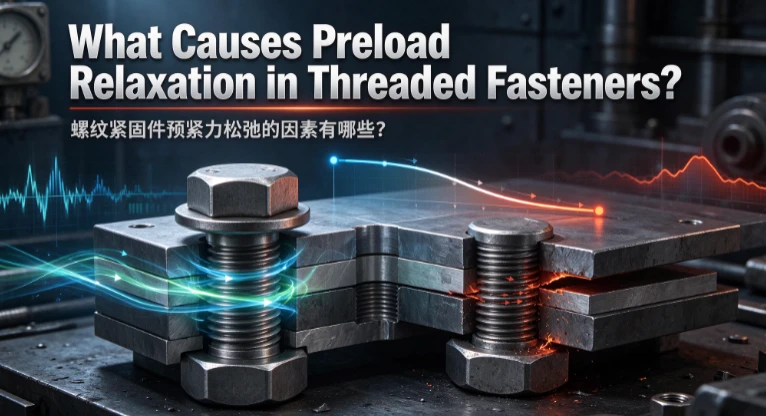
In threaded fastener connections, the main factors leading to preload relaxation include: bearing surface settlement, interaction between bolts in a group, seal ring deformation, high-temperature creep, and torsional stress relaxation.
1. Bearing Surface Settlement
When a threaded fastener is first tightened, the microscopic asperities on the internal and external threads, the bearing surfaces of the bolt and nut, and the mating faces of connected parts make first contact (as shown in Figure 1). These local protrusions carry overload, first reaching the yield point, then undergoing creep deformation until a sufficiently large contact area forms to support the load. Bearing surface settlement is the primary cause of preload relaxation and the most common phenomenon in threaded joints.
This short-term stress relaxation effect is called "settlement." Studies show that the relaxation rate immediately after tightening is the highest and decreases exponentially; after the initial stage, the relaxation rate drops to a very low level (as shown in Figure 2). Typically, preload loss caused by settlement accounts for about 5%–10% of the initial preload.
2. Interaction Between Bolts in a Group
Interaction among bolts mostly occurs in multi-bolt arrangements on the same plane, such as bolted flange connections. When the first bolt is tightened, it elongates and compresses the nearby connected parts. When neighboring bolts are tightened, the connected parts near the first bolt are further compressed, causing the preload of the first bolt to relax. The degree of interaction mainly depends on the stiffness of connected parts, bolt spacing, and whether a seal ring is used. Tests show that preload loss can reach 50% or even 100%.
Taking a certain flange bolt group as an example, 8 bolts are tightened in a diagonal sequence, and the interaction between bolts is shown in Figure 3. Figure 3(a) shows the "zigzag effect" in the first tightening cycle: when the last bolt is turned in by 1/4 turn, the preload it generates is greater than that of adjacent bolts. After four tightening cycles, as shown in Figure 3(b), the final relaxation pattern no longer forms a standard zigzag. In each tightening cycle, the torque applied to the bolts increases in sequence, with the same torque value for each bolt.
3. Seal Ring Deformation
Seal ring deformation is another form of short-term relaxation. A joint with a seal ring experiences greater relaxation than that caused by ordinary settlement. In structural connections, the plastic deformation of the seal ring prevents liquid or gas leakage from pipelines. Similar to other plastic materials, the seal ring undergoes some deformation when first subjected to high surface stress; however, because the deformation depends on many factors, its magnitude is difficult to predict accurately.
For joints containing a seal ring, the load-deflection characteristic is nonlinear (as shown in Figure 4(a)). The seal ring is far more flexible than other parts of the connected components, so its elastic deformation accounts for the vast majority of total deformation. With partial plastic characteristics, the seal ring produces a hysteresis effect (as shown in Figure 4(b)). Under dynamic loading, the hysteresis effect disappears after a period of time; therefore, the analysis methods differ for static and dynamic loads.
4. High-Temperature Creep
High temperature generally reduces material strength and leads to a certain degree of relaxation. During long-term service at elevated temperature, bolts undergo slow creep deformation accompanied by stress relaxation. Under creep, the bolt elongates, increasing the distance between nuts on both sides, reducing flange clamping pressure and lowering sealing performance. Under stress relaxation, elastic deformation transforms into plastic deformation; the bolt axial force decreases as elastic strain reduces, also lowering flange clamping pressure and sealing performance.
5. Torsional Stress Relaxation
During tightening, the fastener bears not only axial stress but also corresponding torsional stress. Torsional stress readily relaxes to varying degrees and is generally considered the stress component most susceptible to relaxation. In most cases, torsional stress disappears immediately after the wrench is removed. Literature shows that torsional stress relaxation generates additional tensile stress. This "self-tightening" phenomenon (as shown in Figure 5) is usually masked by the larger axial settlement relaxation. Torsional stress is mainly determined by thread friction torque and the amount of relaxation; whether relaxation ultimately manifests as head rotation or self-tightening depends on the comparison between bearing surface friction and thread friction conditions.