
Bolt And Nut Anti Loosening Type, Reason For Self-locking Nut Not Loosening
Jul 10, 2023
The issue of preventing loosening of bolts and nuts has always been a hot topic online. Today, Xiaorui will summarize and tell everyone how to deal with the problem of preventing loosening of bolts and nuts in daily life. The author lists the following types of locking bolts and nuts, and uses different types of locking bolts and nuts for connections in different places.
Bolt and nut anti loosening type

Double nut anti loosening, also known as counter nut anti loosening, when two counter nuts are tightened, there is always an interactive pressure between the two counter nuts, which is transmitted to the contact surface of the screw thread. The tighter the counter nuts are tightened, the greater the pressure between the contact surfaces of the screw thread. The greater the contact pressure, the greater the friction resistance distance. Any rotation of the two nuts requires overcoming the friction force between the screw threads. Even if the external load changes, the pressure between the top nuts remains constant, thus providing a relaxing effect.
Application: It can be used in pre tightening connections or bolt connections without pre tightening requirements, only for working conditions with light vibration.
2. Hard lock lock nut

Hard lock lock nuts are a combination of two types of nuts with a "concave" and "convex" shape at the top and bottom. The protruding nut below acts as a wedge by slightly shifting the center during machining (eccentric machining). The concave nut on the top is not subjected to off center machining (circular machining), thus forming the function of hammering and wedging. The "convex" and "concave" surfaces of the upper and lower nuts are both conical surfaces, which can generate significant radial pressure even with small axial pressure. The pressure between the "convex" and "concave" conical surfaces will be transmitted to the bite threads of the upper and lower nuts, and a large frictional resistance distance will be generated between the thread bite surfaces and on the convex and concave conical surfaces, which plays a role in preventing loosening.
Application: It can be used in pre tightening connections or in bolt connections without pre tightening requirements. Can be used for severe vibration conditions.
Disadvantages: Difficulty in processing and high cost.
3. Shi Biliao locking nut
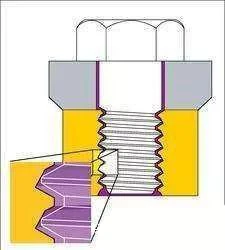
There is a 30 degree wedge-shaped slope at the bottom of the internal thread of the Schbilcher nut. When the bolts and nuts are tightened together, the tooth tip of the bolt tightly presses against the wedge-shaped slope of the Schbilcher thread, generating a significant locking force. Due to the change in the angle of the tooth shape, the directional force generated by the contact between the threads forms a 60 degree angle with the bolt axis, rather than a 30 degree angle like that of regular threads. This results in a much greater pressure in the direction of the screw thread than the tightening pressure, resulting in a significant increase in the anti loosening friction force generated.
Application: It can only be used at bolt connections with preload requirements, and the connected parts cannot be too soft. Once there is a loss of preload, the anti loosening effect will be lost.
Disadvantage: When using the torque method to tighten, in order to obtain a certain pre tightening force of the bolt, a larger torque needs to be applied to overcome the frictional resistance between the threads.
4. Open spring washer anti loosening

The anti loosening principle of spring washers is that after pressing the spring washer flat, the spring washer will generate a continuous elastic force, causing contact pressure between the inner thread of the nut and the outer thread of the bolt. This pressure generates a frictional resistance moment, thereby preventing the nut from loosening. At the same time, the edge at the opening of the spring washer is embedded into the nut and the surface of the connected part respectively, thereby preventing the nut from rotating relative to the connected part.
Usage: It cannot be used at particularly hard connections of connectors. If the connector is harder than the washer, the edge of the washer cannot be embedded into the surface of the connected component, and cannot play a role in preventing loosening. It cannot also be used at connections with high preload requirements, which can cause preload loss and acceleration.
5. Conical spring washer
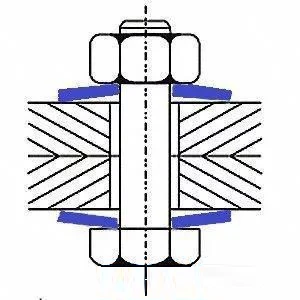
The anti loosening principle of conical spring washers is that after pressing the spring washer flat, the spring washer will generate a continuous elastic force, causing contact pressure between the inner thread of the nut and the outer thread of the bolt. This pressure generates a frictional resistance moment, thereby preventing the nut from loosening. Conical spring washers have higher stiffness than open spring washers, which means that the pressure generated by the same compression amount is greater and the anti loosening effect is better.
Application: Not suitable for connections with high preload requirements.
6. Double stack self-locking washer

This type of washer has a large helical tooth surface on one side and radial serrations on the other side. NORD-LOCK washers are installed in pairs with large tooth surfaces facing each other. When tightening bolts or nuts, the radial serrations tightly grip the contact surface, causing the NORD-LOCK washer to be relatively fixed with the contact surface of the nut and the connecting piece, only allowing relative movement between the large bevel tooth surfaces. Any loosening trend of bolts or nuts is prevented by the wedging effect of large serrations. The lifting distance between two NORD-LOCK washers is greater than the lifting distance of the bolt or nut caused by thread sliding.
Application: It should not be used at joints with particularly hard connecting surfaces. When the connecting surface is particularly hard, the radial serrations cannot bite the contact surface and cannot provide anti loosening effect. The gasket has both positive and negative sides, and if it is installed upside down, it cannot prevent loosening, nor can it be used without pre tightened connections. The connector is too soft and cannot use this type of gasket.
Reason for non loosening of self-locking nut
The principle of self-locking lies in its unique structure.

As shown in Figure 1, there is a 30 ° wedge-shaped slope at the bottom of the female thread. When the bolt and nut are tightened together, the tooth tip of the bolt tightly presses against the wedge-shaped surface of the self-locking thread, resulting in a significant locking force. Due to the change in the angle of the tooth shape, the normal force generated by the contact between threads forms a 60 ° angle with the bolt axis, instead of forming a 30 ° angle like regular threads. Obviously, the normal pressure of the thread is much greater than the tightening pressure, so the generated anti loosening friction force will inevitably increase significantly. When the bolt tension is also P0, the normal pressure of the traditional 60 ° angle thread P=1.15P0,
And the self-locking thread has a wedge-shaped inclined surface with a 30 ° angle at the base of the tooth,
The angle and magnitude of its normal pressure both change, with a normal pressure of P=2P0. The ratio of the two normal pressures is about 12:7, and the anti loosening friction force of the self-locking thread correspondingly increases.
The wedge-shaped surface of self-locking threads can also eliminate problems such as uneven force distribution, tripping and seizure of ordinary threads.
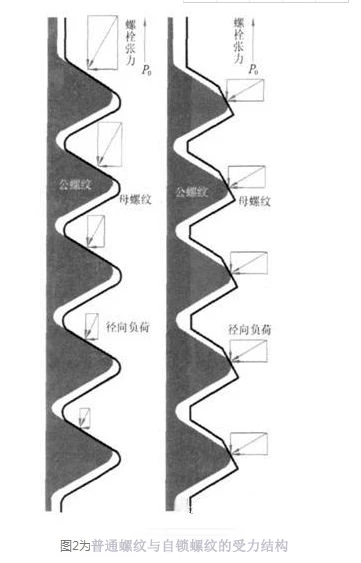
Ordinary threads -60 ° angle V-shaped threads carry 70% to 80% of the load on their first and second thread mating surfaces, while the load on the subsequent mating surfaces is minimal. In this way, under the working vibration load, ordinary Threaded fastener can easily overcome the locking force on the thread contact surface to produce rotation, and then become loose, which is why ordinary Threaded fastener become loose.