

Benefits Of Nut Galvanizing
Jan 23, 2026
Commonly used Grade 8 and Grade 4 nuts basically require galvanizing treatment. First, it enhances the appearance. Nuts before galvanizing are in their natural color, appearing dull and having little aesthetic value, while galvanized nuts have a bright and smooth surface. Moreover, different types of zinc coatings such as white zinc, blue-white zinc, and colored zinc can be applied according to requirements. The second reason for nut galvanizing is certainly rust prevention. Non-galvanized nuts tend to rust after two or three months of use, whereas galvanized nuts can remain rust-free for up to five years, indicating that galvanizing offers excellent anti-corrosion effects. The third advantage of galvanized nuts is ease of installation. You may wonder what relationship exists between nut galvanizing and installation. For most nuts, the first step of installation requires hand-screwing a few threads before tightening with tools. Without galvanizing, the nut surface may either have oil stains that soil hands or burrs that can scratch hands; wearing gloves would reduce operational sensitivity. Therefore, installing non-galvanized nuts is time-consuming and laborious, while galvanized nuts can be directly held and screwed by hand, making the process very convenient and efficient.
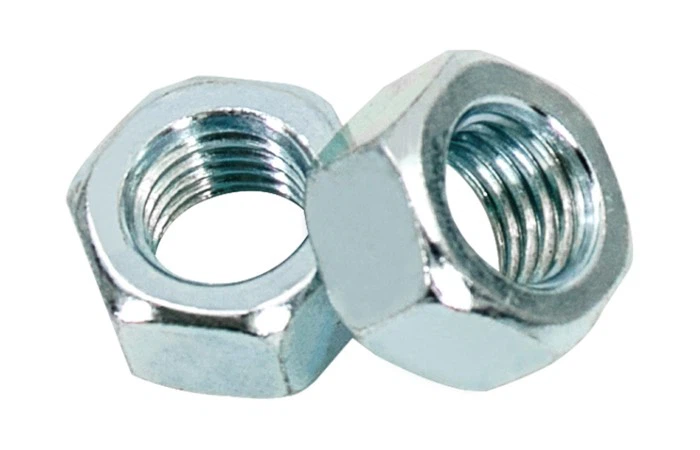
Although nut galvanizing is a simple and commonly used process, the threads after electroplating must pass the go-no-go gauge test. Hence, relevant standards have been formulated in the electrogalvanizing industry, which are implemented in accordance with the specification GB/T 5267.1 Fasteners - Electroplated Coatings. This standard specifies the zinc coating thickness and corrosion resistance duration. Since nuts have internal threads, to prevent incomplete zinc plating on the internal threads, the tolerance of the zinc coating thickness is controlled at around 15 microns as an upper limit, while the standard coating thickness for bolts is about 7 microns. The upper-limit tolerance for nuts is set to ensure that the internal threads are fully covered with zinc. Therefore, there are occasions where the go gauge cannot pass through galvanized nuts. As long as it is within the allowable range specified by standards, such nuts are acceptable, because this is not a quality defect but a result of reduced thread clearance caused by the zinc coating.
Measuring the zinc coating thickness of nuts is very simple. Traditional methods such as the spot test and timed flow test have been completely phased out. We only need to purchase a small handheld instrument, and the zinc coating thickness parameters can be directly read by placing the instrument against the nut surface. At present, the price of electrogalvanizing has slightly increased, but from a long-term perspective, this upward trend will continue. There is a wide range of galvanized nut specifications available. Fan'ao Company keeps in stock galvanized nuts ranging from as small as M2 to as large as M64, with abundant inventory for most sizes. However, M2 nuts are rarely used, and most customers purchase galvanized nuts starting from M3.


