
Research On Structure, Performance, Application And Development Trend Of Torsional Shear High-strength Bolts
Sep 24, 2026
1 Introduction
Bolts are the most widely used fasteners in engineering structures, which directly determine the connection stability and overall safety of steel structures in buildings, bridges and machinery. As a new type of assembled high-strength fastener, torsional shear high-strength bolts have remarkable advantages such as convenient construction, accurate pre-tightening force, uniform connection and excellent seismic performance. They have been widely adopted and studied in various steel structure projects, serving as core components for connections in modern prefabricated buildings and heavy-duty structures. This paper systematically describes the structural configuration, working principle and core mechanical properties of torsional shear high-strength bolts, sorts out their engineering application scenarios, and analyzes their future research and application development trends combined with the current industrial status.
2 Structure and Working Principle of Torsional Shear High-strength Bolts
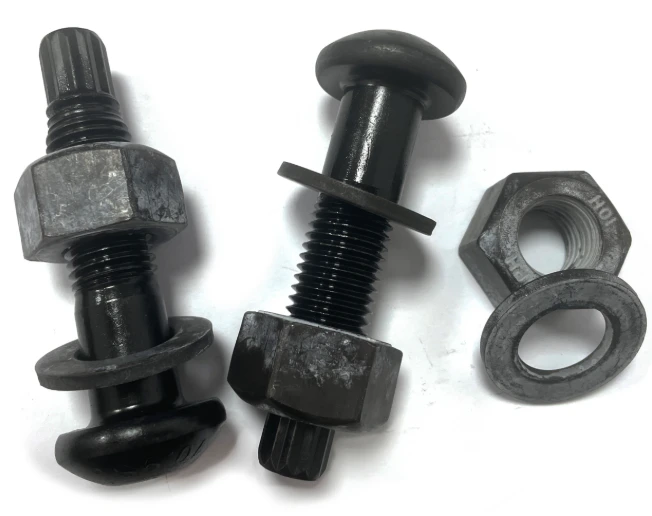
A torsional shear high-strength bolt consists of a bolt shank, a special nut, washers, a torsional shear groove at the tail, a plum-blossom driving head and a shear neck. Compared with traditional high-strength bolts, it has a dedicated structure. Its key structural feature is a precisely reduced shear neck and a plum-blossom driving end machined at the bolt tail, which realizes torque-controlled final tightening and accurate preload.
Its construction working principle differs from the energy dissipation mechanism via torsional shear deformation of ordinary bolts. During installation, a special torsional shear wrench is used; the inner and outer sleeves clamp the plum-blossom head at the bolt tail and the nut respectively to apply torque synchronously. As the nut is continuously tightened, the bolt pre-tightening force rises steadily. When the pre-tightening force reaches the designed standard value, the shear force borne by the shear neck at the bolt tail reaches its limit, and the plum-blossom head at the tail will be sheared off automatically to terminate construction. This structure can precisely control the bolt pre-tightening force and avoid connection loosening, insufficient preload or over-tightening damage caused by manual torque deviation, achieving standardized and high-precision assembly.
3 Core Performance of Torsional Shear High-strength Bolts
3.1 High-strength Mechanical Performance
Torsional shear high-strength bolts are mostly manufactured from high-quality alloy structural steel through quenching and tempering heat treatment, with a common strength grade of 10.9. They have excellent tensile, shear and compressive mechanical properties. Compared with ordinary bolts, their yield strength, tensile strength and fatigue resistance are greatly improved. They can withstand long-term working conditions with large loads and high stress in steel structures, fully meeting the high-strength connection design requirements of high-rise buildings, long-span bridges and heavy steel structures, and offering stronger structural load stability.
3.2 Good Seismic Performance and Structural Stability
Torsional shear high-strength bolts achieve tight contact via accurate and uniform pre-tightening force with minimal gaps on contact surfaces. They can effectively restrain sliding and loosening of structural connections under vibration and alternating loads. Under alternating external loads such as earthquakes and wind forces, the bolted connection bears uniform stress, which can effectively distribute and transfer structural stress, reduce local stress concentration, lower the risk of structural deformation and connection failure, and significantly improve the overall seismic performance and fatigue durability of steel structures.
4 Engineering Applications of Torsional Shear High-strength Bolts
Benefiting from high assembly accuracy, fast construction speed, reliable connection and good seismic performance, torsional shear high-strength bolts are widely used in key connection positions of various steel structures. In the construction sector, they are mainly used for steel frame connections of high-rise and super high-rise buildings and prefabricated steel beam-column joints. In transportation engineering, they are extensively applied to long-span steel bridges, bridge support structures and steel connections of walkways. Besides, they are suitable for engineering machinery, aerospace tooling structures, large-scale equipment steel supports and other scenarios requiring high connection precision and safety. Such bolts can effectively guarantee the stability, safety and durability of the overall structure and meet the construction requirements of modern high-standard steel structure projects.
5 Future Development Directions of Torsional Shear High-strength Bolts
5.1 Research and Development of High-performance Special Materials
Future research can focus on the development and application of new high-strength, high-toughness and corrosion-resistant special alloy materials, and optimize steel heat treatment processes. This further improves the bolt strength grade, low-temperature toughness, corrosion resistance and fatigue resistance to adapt to extremely harsh engineering conditions such as marine salt spray, low cold temperature and chemical corrosion, expanding its application scope in special scenarios.
5.2 Structural Design Optimization
Combined with the actual stress characteristics in engineering, optimize the dimensional design of the shear neck, thread profile and shank structure to further enhance pre-tightening force accuracy and torque stability of the structure. Meanwhile, optimize the product matching system, develop new torsional shear bolt structures adapted to special-shaped structures, narrow spaces and heavy-load working conditions, and improve product versatility and adaptability.
5.3 In-depth Research on Numerical Simulation and Experiments
With finite element numerical simulation technology combined with static loading, fatigue loading and seismic impact tests, systematically study the mechanical response, failure mechanism and deformation law of torsional shear high-strength bolts under complex loads, alternating vibration and extreme temperatures. Improve its stress theoretical system and provide more scientific and accurate theoretical and experimental basis for engineering design, construction specification optimization and safe application.
6 Conclusion
As high-performance special fasteners suitable for modern steel structure engineering, torsional shear high-strength bolts have outstanding advantages including high strength, accurate preload, efficient assembly, good seismic performance and reliable connection. They enjoy broad application prospects in steel structure fields such as construction, bridges and high-end equipment. At present, this type of bolt still has limitations including poor adaptability to extreme working conditions and single structural system. In the future, multi-dimensional research such as special material development, structural design optimization and improvement of numerical simulation and experimental systems can further enhance its mechanical performance and environmental adaptability, expand its application scope, promote the popularization of torsional shear high-strength bolts in high-end, complex and extreme engineering scenarios, and provide solid support for the safe and stable operation of steel structure projects.