
The Tighter The Bolt Is, The Better? Or Is It Better To Back Off Half A Turn After Tightening? Is There Any Scientific Basis?
May 18, 2023
When many people fix mechanical equipment, they will screw the bolts until they cannot be screwed. Is this method good? Not exactly. Some people also say that after the bolt is tightened, it can be tightened by half a turn, so that it can be tightened more. Is this statement correct? Is there any scientific basis? In fact, many believers in life will think so, and the scientific basis Where is it?

The tighter the bolt is, the better? Or is it better to back off half a turn after tightening?
A screwed bolt is acted upon by two forces, one downward and one upward. The bolt rotates down along the thread, and a downward axial force is generated in the process of contacting with the thread.
At the same time, there is an upward force corresponding to the downward axial force, which comes from the upward distributed force generated by the contact between the nut and the lower plane. A tightened bolt should ensure that the up and down forces are balanced. Due to the function of bolts, the material for making bolts has two requirements, one is rigidity, the other is toughness, both are indispensable.
But all ductile materials have one thing in common, that is, there is a limit to the bearing of stress. In mechanics, this limit is represented by a stress-strain curve. We don't need to get too esoteric. We only need to know that in the process of screwing the bolt, the bolt is an elastic part, and its elasticity will work.
As the bolt is gradually tightened, the elastic effect of the bolt will approach a limit, and once this limit is broken, the bolt will enter the yield stage from the elastic stage.
Once the bolt enters the yield stage, it will produce permanent deformation, which is irreversible, that is to say, the bolt will fail. In real life, when we continuously tighten the bolts, the tripping phenomenon is caused by this reason, and once the bolts are tripped, it is impossible to screw them on again, because the bolts have been permanently deformed. It can be seen that the bolts are not screwed properly. The tighter the better.

So, when tightening the bolt, do you really have to tighten it and then return it half a turn? No. As we said, once the limit is exceeded when the bolt is tightened and the yield stage is entered, the bolt will be permanently deformed, and it will be useless to return half a turn at this time. On the contrary, the returned bolt will lose part of its toughness and will break more easily.
If the degree of tightening of the bolt has not exceeded the limit, it is even more unnecessary to retreat half a turn, which will only loosen the bolt.
So when can the bolt go back half a turn after tightening?
Be aware that bolts that are not tightened will become looser and looser due to vibration during use. So no matter whether the bolt is tightened beyond the limit or not, it is harmful and useless to retreat half a turn. Of course, there is one exception, and that is when there are spacers. Some things will equip the bolts with washers.
So what is the function of this thin ring-shaped small metal piece? In fact, the function of this metal piece is equivalent to a spring, and the purpose is to increase elasticity. The purpose of adding elasticity is to make the whole assembly stronger. However, as a spring component, the gasket has a limited bearing capacity as well. The so-called spring means that after being squeezed, it will deform, and due to its own elasticity, it will recover after the pressure is removed, but the restoring force of the spring is limited.
When the pressure on the gasket is too large, so that when it exceeds the limit, its spring action will disappear, so the existence of this gasket is unnecessary.
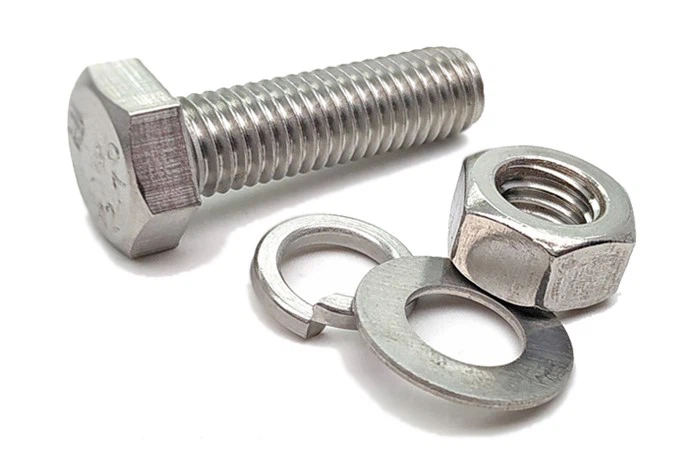
In order to maintain the elastic effect of the gasket and make the whole assembly stronger, after tightening the bolts, we can retreat half a turn to maintain the elasticity of the gasket, which is more conducive to the firmness of the entire assembly. But the premise is that it must be ensured that the bolts are not deformed due to overtightening.
So how can we ensure that the bolts are not tightened too tightly? When manufacturing precision instruments, we need to use a torque wrench that can measure force, but in daily life, it is a bit superfluous to do so. In daily life, screwing bolts mainly depends on experience and hand feeling. In addition, don't be influenced by obsessive-compulsive disorder, and don't keep screwing and screwing. With or without washers, bolts are not as tight as possible. For bolts without washers, it is wrong to retreat half a turn after tightening.