
Surface Treatment Of Fasteners - Electroplating
Nov 15, 2023
1】、 Electroplating code:
When it comes to the identification of riveted fasteners, we mentioned the suffix codes for surface treatment, which represent the type of plating on their surface.
Below, we have compiled detailed information on some common surface treatment methods commonly used in fasteners. The following table shows:
| FINISH | Code | |
| Galvanizing | ZINC CLEAR | ZI |
| ZINC BLUE | ZU | |
| ZINC YELLOW | ZC | |
| ZINC BLACK | ZB | |
| Nickel plating | NICKEL FLASH | NI |
| Chrome plating | CHROME FLASH | CR |
| Tin plating | TIN FLASH | ET |
| Natural color | NATURAL | NL |
| Oxidation | NATURAL ANODIZE | NA |
| BLACK ANODIZE | BL |
2】、 Regarding electroplating:
Electroplating is the process of coating fasteners with a metal coating to change their surface properties and prevent oxidation and corrosion. The coating metal is generally made of corrosion-resistant metals.
Electroplating not only enhances the corrosion resistance of fasteners, but also increases hardness to prevent wear, improve conductivity, heat resistance, and make the surface smoother and more aesthetically pleasing.
Electroplating is the process of using electrolysis to attach a metal film to the surface of metal or other materials. Below is a brief introduction to some commonly used coatings for fasteners.
1. Electrogalvanizing
Electrogalvanizing is the most commonly used coating for fasteners, which has a good appearance and is relatively cheap. It comes in colors such as white zinc, blue zinc, color zinc, and black zinc. Compared with other metal coatings, zinc is a relatively inexpensive and easy to electroplate metal. However, its anti-corrosion performance is average, and the neutral salt spray test of zinc plating takes less than 72 hours. Of course, special sealing agents are also used, which can make the neutral salt spray test more than 200 hours. However, the price is 5-8 times more expensive than that of ordinary zinc plating.
The following figure shows the screws plated with blue and white zinc:

The following figure shows the bolts for electroplating colored zinc:

2. Electroplated nickel
Electroplated nickel fasteners are generally used in areas that require both high corrosion resistance and good conductivity. The stability of electroplated nickel layer in air is very high. Due to the strong passivation ability of metallic nickel, an extremely thin passivation film can be quickly formed on the surface, which can resist the corrosion of atmosphere, alkali, and certain acids. Electroplated nickel has excellent polishing performance, and its luster can be maintained for a long time after polishing. Moreover, the higher hardness of the nickel coating can improve the wear resistance of fasteners.
The following figure shows the hexagonal socket bolts with nickel plating:

3. Oxidation
Oxidation blackening+oil coating is a popular coating for industrial fasteners because it is the cheapest and looks good before fuel consumption. In the presence of oil, the salt spray test can only last for 3-5 hours. The consistency between torque and pre tightening force of blackened fasteners is also poor. If it needs to be improved, grease can be applied to the inner threads during assembly before screwing in.
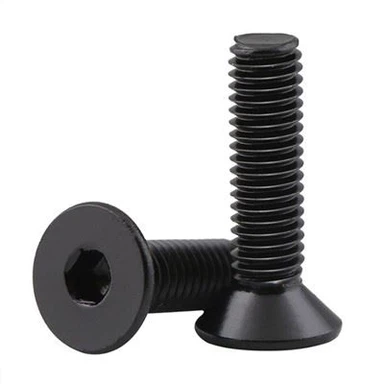
The following figure shows the oxidized and blackened bolts:

4. Chromium plating
The use of chromium plating on fasteners is generally used for decorative purposes. The chromium coating is very stable in the atmosphere, not easy to change color and lose luster, and has high hardness and good wear resistance. Good chrome plated fasteners are equally expensive as stainless steel, but they are only replaced by chrome plated fasteners when the strength of stainless steel is insufficient. Therefore, they are rarely used in industrial fields with high anti-corrosion requirements. To prevent corrosion, copper and nickel should be plated first before chrome plating. Chromium plating can withstand high temperatures of 650 ℃, but it has the same problem of hydrogen embrittlement as electrogalvanizing.
The following figure shows the bolts with chrome plating:

3】、 Electroplating standards and quality inspection:
The national standard for surface treatment of fasteners GB/T5267.1-2002 is the standard for electroplating coatings on threaded fasteners. This standard includes two standards: GB/T5267.1-2002 electroplating coatings on fasteners and GB/T5267.2-2002 non electrolytic zinc sheet coatings on fasteners. This standard is equivalent to the international standard ISO4042-1999 for electroplating coatings on threaded fasteners.
The main purpose of surface treatment of fasteners is to improve their corrosion resistance and increase their reliability and adaptability. The main measure is corrosion resistance, followed by appearance.
The quality of the electroplating coating on fasteners is mainly judged from the following aspects:
1. Visual inspection
The surface of fasteners should be smooth, with good glossiness and no missed plating layer. There should be no dirt, pores, pinholes, peeling, scorched coating, dull, peeling, skinning, and obvious stripes, as well as pits, black plating slag, loose, cracked, peeled off passivation film, and severe passivation marks.
2. Coating thickness
The coating thickness of fasteners is directly related to their corrosion resistance in the atmosphere, but if it is too thick, thread interference may occur during installation. It is recommended to have a coating thickness of 4-12um generally.
The average thickness of hot-dip galvanizing standard is 54 um (43 um for diameters ≤ 3/8), and the minimum thickness is 43 um (37 um for diameters ≤ 3/8).
3. Coating distribution
The aggregation of coatings on the surface of fasteners varies with different deposition methods. During electroplating, the metal coating is not uniformly deposited on the outer edges, and a thicker coating is obtained at the corners. In the threaded part of the fastener, the thickest coating is located at the top of the thread, gradually thinning along the side of the thread, and depositing the thinnest layer at the bottom of the thread.
On the other hand, hot-dip galvanizing is the opposite, with thicker coatings depositing at the inner corners and at the bottom of the threads. The metal deposition tendency of mechanical plating is the same as that of hot-dip galvanizing, but it is smoother and has a much more uniform thickness on the entire surface.
4. Hydrogen embrittlement
During the processing and treatment of fasteners, especially during acid and alkali washing before plating and subsequent electroplating processes, the surface absorbs hydrogen atoms and generates hydrogen during the deposition process. When the fastener is tightened, hydrogen is transferred towards the most concentrated part of the stress, causing the pressure to increase beyond its strength and causing small surface fractures. Hydrogen seeps into the newly formed cracks. This cycle of pressure rupture infiltration continues until the fastener fractures. Usually occurs within a few hours after the first stress application. In order to eliminate the threat of hydrogen embrittlement, fasteners need to be heated and baked within 3 hours after plating to allow hydrogen to seep out of the coating, usually at a temperature of around 200 ℃, and the processing time is determined based on their required tensile strength.
Due to the fact that mechanical galvanizing is non electrolyte, it effectively eliminates the threat of hydrogen embrittlement, so hot-dip galvanized fasteners rarely experience hydrogen embrittlement.
4】、 Heat treatment of fasteners:
Heat treatment is the process of heating, insulation, and cooling fasteners to change their internal structure and achieve the expected performance, organization, and structure. Annealing, normalizing, quenching, and tempering are the "four fires" in heat treatment, among which quenching and tempering are closely related and often used together.
Annealing is the process of heating a workpiece to an appropriate temperature and holding it for a certain period of time, then slowly cooling it to achieve or approach an equilibrium state of its internal structure, allowing the internal stress generated by the previous process to be released, and obtaining good process and usage performance as preparation for further quenching.
Normalizing is the process of heating a workpiece to a suitable temperature and then cooling it in air. The effect of normalizing is similar to annealing, but the resulting microstructure is finer and is commonly used to improve the cutting performance of materials. It can be used as the final heat treatment for some parts with low requirements.
Quenching is the rapid cooling of a workpiece in a quenching medium such as water, oil, or other inorganic salt solutions or organic water solutions after heating and insulation.
Tempering refers to holding the quenched workpiece at an appropriate temperature above room temperature but below 650 ℃ for a long time, followed by cooling, which can reduce the brittleness of the quenched workpiece.
The four fires evolved into different heat treatment processes with different heating temperatures and cooling methods. The process of combining quenching and high-temperature tempering to obtain a certain level of strength and toughness is called quenching and tempering.