

Properties And Classification Of Stainless Steel Fasteners
Apr 10, 2023
Stainless steel fasteners mainly use stainless steel wires as raw materials, and then perform a series of processes such as piercing according to the steps of producing standard parts. Using stainless steel to manufacture fastener products has become very popular. Stainless steel fasteners have the following major properties:
1. High temperature resistance of stainless steel fasteners. Since the hardness of stainless steel itself is relatively strong, the fasteners after production have strong oxidation resistance, and they cannot work normally at high temperatures, and will not be too much disturbed by high temperatures. If they can be manufactured at the same time Passivation, then the effect will become better and better.

Second, the physical properties of stainless steel fasteners have a relatively high electronegative rate. Compared with carbon steel wire, we can see that the electronegative rate of stainless steel fasteners is five times higher than that of carbon steel. There is a coefficient of expansion in the standard parts. After testing, we know that if the temperature is higher, the coefficient of expansion of stainless steel fasteners will increase to a certain extent.
3. The force bearing capacity of stainless steel fasteners. For stainless steel fasteners, the load they can withstand is relatively large. Although they cannot be compared with high-strength bolts, they also meet the needs of normal people.
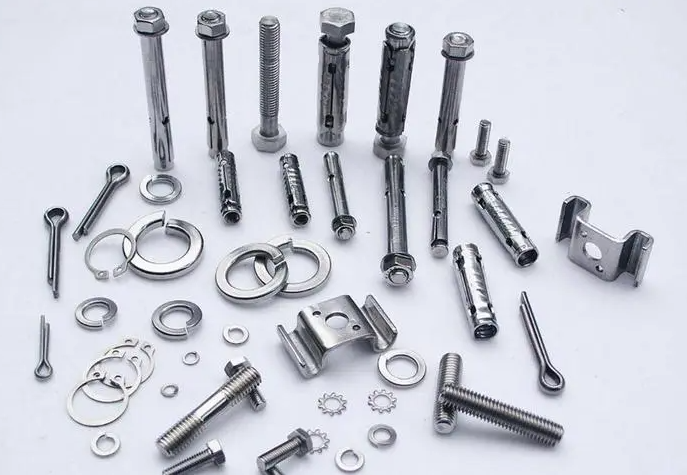
Fourth, the mechanical properties of stainless steel fasteners. In terms of mechanical properties, we can know that many of them have a great relationship with stainless steel wire. For example, no rust and high corrosion resistance are closely related to the properties of stainless steel. With the continuous development of standard parts, these mechanical properties have also become stronger and stronger.
Fasteners are characterized by a wide variety of specifications, different performances and uses, and a high degree of standardization, serialization, and generalization. Materials commonly used in the manufacture of fasteners are carbon steel, low alloy steel and non-ferrous metals.

According to the material of stainless steel, it can be divided into (1) standard austenitic stainless steel (2) martensitic stainless steel (3) ferritic stainless steel (4) precipitation hardening stainless steel,
Among them, what we call standard austenitic stainless steel, commonly used grades are 302, 303, 304, and 305, which are the four grades of so-called "18-8" austenitic stainless steel. Whether it is corrosion resistance, or its mechanical properties are similar. The starting point for selection is the process method of the fastener, and the method depends on the size and shape of the fastener, and also depends on the quantity.

Type 302 is used to manufacture screws and self-tapping bolts.
Type 303 has a small amount of sulfur added to improve performance and is mainly used for standard nuts.
Type 304 is suitable for warm heading process, such as longer specification bolts, large diameter bolts.
Type 305 is suitable for manufacturing fasteners by cold heading process, such as cold formed nuts and hexagonal bolts.
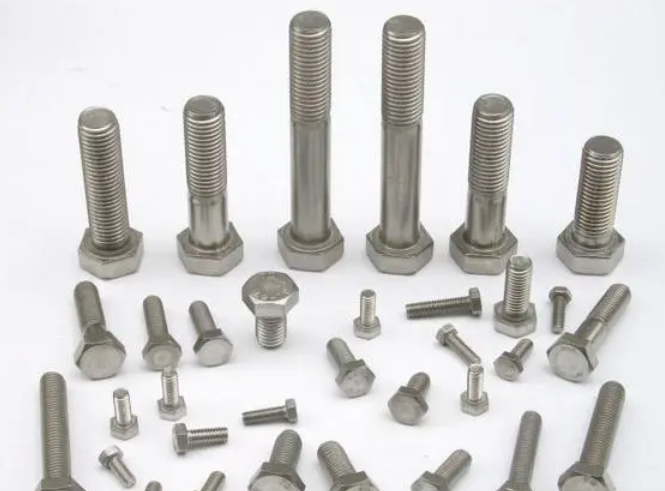
Type 309 and Type 310, which have higher chromium and nickel content than Type 18-8 stainless steel, are suitable for fasteners manufactured at high temperatures.
316 and 317 types, they both contain alloying element manganese, so their high temperature strength and corrosion resistance are higher than those of 18-8 stainless steel.
Type 321 and Type 347, Type 321 contains titanium, a relatively stable alloying element, and Type 347 contains niobium, which improves the intergranular corrosion resistance of the material.


