
Causes Of Loosening Of Threaded Fastener Connections And Common Anti-Loosening Structures
May 29, 2026
Threaded fastener connection is the most basic and commonly used connection method in mechanical assembly. During service, fasteners are prone to loosening under the influence of equipment vibration, alternating loads, impact loads and other working conditions, which directly reduces the assembly accuracy and operational safety reliability of equipment, and further affects product quality and production efficiency. This paper comprehensively analyzes the main causes of loosening of threaded fastener connections, and introduces commonly used anti-loosening structures and protective measures, providing a reference for the rational application of threaded connectors.
1 Causes of Loosening of Threaded Fastener Connections
The core principle of threaded fastener connection is to compress and fix the connected parts through the axial preload generated by bolt tightening. The attenuation or failure of axial preload after bolt tightening is defined as threaded connection loosening. The main causes of threaded connection loosening are summarized as follows:
1.1 Design Defects
(1) Improper Bolt Selection
During bolt tightening, the clamping force of the connection increases with the rise of bolt preload. When the preload reaches the yield strength of the bolt material, plastic deformation occurs on the bolt. In this case, continuous increase of preload leads to negligible or no growth of clamping force. Excessive over-tightening will gradually reduce the clamping force and eventually cause bolt fracture. Therefore, designers shall accurately calculate the bolt tightening torque, and select appropriate bolt specifications and connection schemes based on the weight of parts, bearing working conditions, safety specifications and other parameters, so as to avoid loosening and fracture failures caused by improper selection.
(2) Missing or Unreasonable Anti-Loosening Design
Threaded connections work continuously under complex working conditions such as vibration, alternating loads and impacts. In the absence of effective anti-loosening structures or with improperly matched anti-loosening schemes, failures such as thread loosening and falling off of bolts and nuts are likely to occur. Accordingly, targeted anti-loosening measures shall be configured according to equipment operating conditions in the product design stage to prevent connection failure under severe working conditions.
1.2 Insufficient Preload
The preload generated after bolt tightening directly determines the clamping effect between connected parts, and insufficient preload is one of the core causes of threaded connection loosening. Standard assembly requires the bolt preload to be close to or reach the yield strength of the material to ensure connection stability. However, in actual production and assembly, many factors lead to substandard tightening torque, including limited operating force of workers and mismatched assembly tools. In addition, some process documents fail to specify standard bolt tightening torque, and no special torque tools are equipped at assembly stations. Operators judge the tightening state merely by experience and intuition, resulting in insufficient preload of bolts in vibration-prone areas and loosening failure after long-term operation.
1.4 Induced Loosening by Bearing Surface Depression Deformation
When the bearing surfaces of bolts and nuts and the contact surfaces of connected parts bear compressive loads, excessive local stress will cause plastic deformation such as surface depression and collapse. The deformation of bearing surfaces directly leads to the attenuation or complete loss of effective bolt preload, increases the fit clearance of threaded connections, and finally causes loosening failure of fasteners.
1.4 Non-Standard Assembly Processes
For assembly structures with regularly distributed multiple bolts, the lack of standardized tightening process specifications will lead to unbalanced stress and inconsistent tightness of each bolt due to disordered tightening sequences when operators work purely by experience, resulting in connection loosening. For example, square-distributed mounting bolts shall be tightened diagonally and in multiple passes to ensure uniform stress on all bolts. Non-standard assembly processes will not only cause bolt loosening, but also lead to deformation of connected parts and out-of-tolerance assembly accuracy due to uneven stress distribution.
1.5 Processing Quality Defects of Parts
The machining accuracy of threaded holes and bolt mounting holes directly affects the assembly quality and preload effect of threaded connections. Aperture deviation is a key factor causing loosening: undersized holes lead to assembly difficulties and inadequate thread fitting; oversized holes reduce the contact area between bolt/nut bearing surfaces and connected parts, causing local stress concentration and depression deformation, which destroys the pre-tightening state and ultimately results in loosening failure of fasteners.
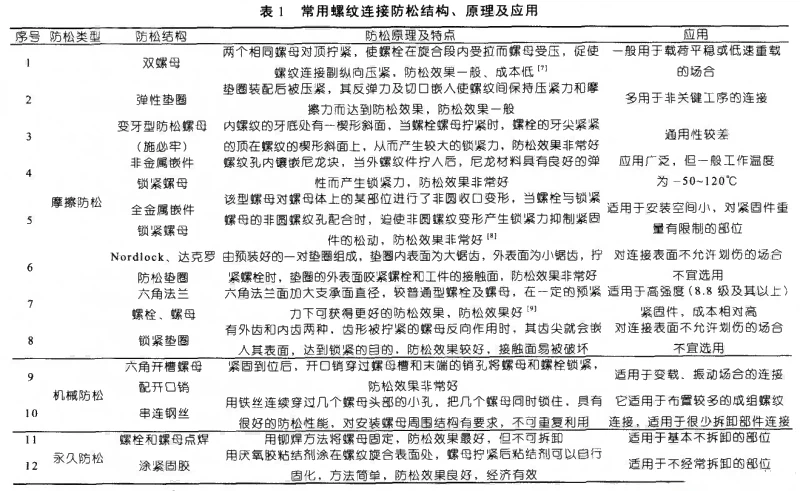
2 Common Anti-Loosening Structures for Threaded Fastener Connections
According to working principles, anti-loosening structures for threaded connections are divided into three categories: friction anti-loosening, mechanical anti-loosening and permanent anti-loosening. The working principles and application scenarios of each type are as follows: