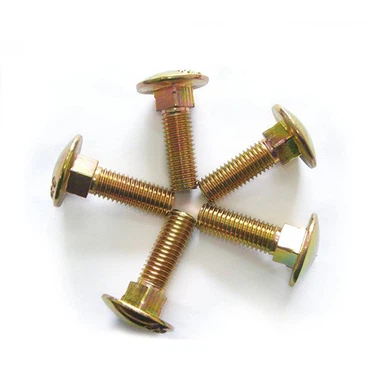

Blackening Process And Precautions For Hexagonal Bolts
Jul 14, 2026
Blackening treatment is a common surface oxidation and anti-corrosion process for steel materials. According to process temperature and treatment effects, it is mainly divided into three types: low-temperature blackening, high-temperature blackening, and optical matte blackening. Each process differs in coating performance, surface appearance and applicable scenarios.

I. Introduction to Three Main Blackening Processes
1. Low-temperature Blackening Process
The low-temperature blackening process delivers stable product quality. The formed oxide film is dense, firm and well-adhered. After oil sealing, the surface presents an even deep black color with moderate wear resistance, complying with the national standard GB/T15519. Featuring high cost performance, this process is widely used for conventional fastener anti-corrosion treatment. However, its corrosion resistance and wear resistance are inferior to those of the high-temperature blackening process.
2. High-temperature Blackening Process
High-temperature blackening offers the best comprehensive performance with excellent treatment results. The oxide film formed features ultra-strong adhesion and uniform density. The treated bolt surface possesses multiple properties including wear resistance, friction reduction, scratch resistance, seizure resistance, fatigue resistance, corrosion resistance and self-lubrication. It is suitable for the anti-corrosion treatment of high-strength, high-precision and heavy-load hexagonal bolts, serving as the preferred blackening process for high-end fasteners.
3. Optical Matte Blackening Process
Adopting specially formulated chemicals and exclusive technical procedures, the optical matte blackening process forms a non-reflective matte black oxide film on bolt surfaces. The coating boasts strong adhesion, stable structure, no ash residue and no particle defects, with favorable wear resistance. It is applicable to precision hexagonal bolts with special requirements for appearance texture and matte visual effect.
II. Operational Precautions for Hexagonal Bolt Blackening Treatment
1. Complete Thorough Degreasing in Pre-treatment
Normal-temperature blackening solution is acidic and has no degreasing capability. All surface oil contaminants must be completely removed in the pre-treatment stage. Appropriate degreasing methods can be selected according to actual production conditions. After degreasing, workpieces shall be fully rinsed with clean water. Floating oil stains in the rinsing tank must be removed in a timely manner to prevent secondary contamination. The qualification standard for degreasing is a uniform and continuous water film covering the entire workpiece surface. Water droplet aggregation or discontinuous water films indicate incomplete degreasing. Rework is mandatory, and oily workpieces are prohibited from entering the blackening tank.
2. Precisely Control Film-forming Time for Different Materials
Steel materials of different grades have varying film-forming speeds. Operators shall continuously observe film growth during production and take out workpieces immediately after a uniform gray-black oxide film is formed. The workpieces shall be left in the air for 1 to 2 minutes before the dehydration oil immersion process. After being soaked in anti-rust dehydration oil, the blackness, adhesion and compactness of the oxide film will be significantly improved, ensuring stable product quality while controlling production costs.
3. Conduct Film Quality Inspection During Air Standing
Random quality inspection shall be performed while the blackened workpieces are standing in the air after normal-temperature blackening. Products with mottled patterns, exposed substrate or rubbing-off black coating are forbidden to enter subsequent processes, especially oil immersion. Process problems must be investigated and rectified immediately to prevent defective products from flowing into subsequent production procedures.
4. Judge Coating Peeling Defects and Implement Targeted Rectification
Coating peeling mainly results from two causes and can be judged by surface conditions. If only the surface black layer peels off without exposing the steel substrate, the defect is caused by excessive blackening soaking time. If the coating completely falls off and exposes the metal substrate, the pre-treatment including degreasing and derusting is incomplete, and full pre-treatment and re-blackening are required.
5. Stabilize Solution Concentration to Ensure Pre-treatment Quality
The concentrations of degreaser and hydrochloric acid working solution shall be regularly monitored and maintained during production, especially the concentration of hydrochloric acid. Stable solution parameters are the fundamental guarantee for qualified pre-treatment, uniform blackening film and reliable coating adhesion.