
Analysis Of Bolt Material
Apr 18, 2024
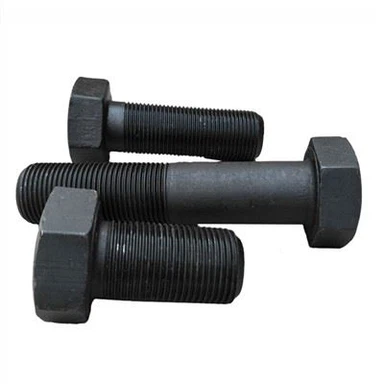
A bolt is a type of fastener that can be divided into ordinary bolts and high-strength bolts according to their different tensile strength. Different bolt materials can also affect the performance and range of use of bolts. Now let's take a look at the material analysis of bolts for your reference.

Ordinary bolt material
Ordinary bolts are divided into two levels: grade 8.8 below and grade 8.8 above. When the bolt belongs to grade 8.8 or below, its nominal tensile strength should reach grade 400 MPa, and the yield strength ratio should be 0.6. The nominal yield strength should reach grade 400 × 0.6=240 MPa. There are many types of materials for ordinary bolts, and the following materials can be considered when choosing:
-1008K
-1010
-1015K
-1032
-1035
-1040
-CH38F
-1039
-Other materials and properties
The above materials are all non-magnetic materials, and their tensile strength and yield strength also meet the nominal requirements. However, it should be noted that 304M has slight magnetism (around 1.6u-2.0u) after cold processing, 304HC has magnetism (around 1.01u-1.6u), and the magnetism of 316 material after cold processing is less than 1.01u.
High strength bolt material
High strength bolts require materials with higher tensile strength to meet higher tightening force requirements. Quenching treatment has a significant impact on the maximum tensile strength of materials. After 40Cr quenching treatment, it is generally difficult to meet the material requirements of 10.9S grade high-strength bolts. Therefore, in cases where the inspection is not too strict, the maximum tensile strength of the material can be determined by the surface hardness after quenching treatment. Under high stress conditions, high-strength bolts of different materials will also have different delayed fracture performance.
The selection and use of high-strength bolts also need to be determined based on specific circumstances. 40Cr high-strength bolts are mainly used in bolted ball joint grid structures, with a design strength generally of 390MPa (d>=30mm) or 430MPa (d<30mm), and there is no high pre tensile stress during use. When used in situations where high pre tension is to be applied, it is necessary to pay attention to and ensure its delayed fracture performance. The delayed fracture performance of 20MnTiB high-strength bolts is better than that of 40B.
According to the GB/T1231-91 standard, it is recommended to use 20MnTiB material (applicable specification<=M24) and 35VB material (applicable specification<=M30) for 10.9S bolts. In quenching treatment, large-diameter high-strength bolts are not easily quenched, so in general, high-strength bolts with excessively large diameters should not be used. If they are to be used, their working stress should be reduced.
summary
The above is the relevant content of bolt material analysis. Whether it is ordinary bolts or high-strength bolts, different materials will have a certain impact on their performance and range of use. Therefore, when selecting and using bolts, it is necessary to determine the appropriate bolt material based on specific requirements.