Countersunk screw is also called flat machine screw and flat head screw. Its head is a 90 degree cone, and the surface of the mounting hole on the connector is also processed with a 90 degree cone socket, so as to ensure that the screw head is parallel to the surface of the connector, and it is used to allow a little protrusion on the surface. And why do we always encounter the phenomenon of untightening when we use it?
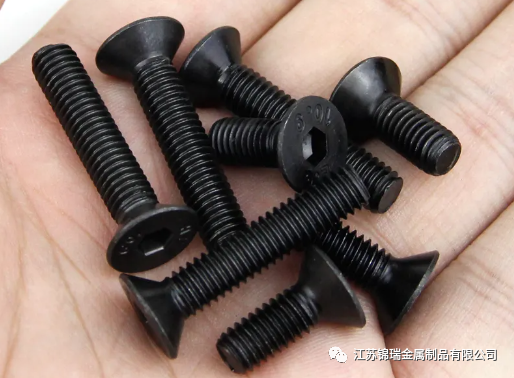
Reasons and precautions for the loose countersunk screws shared by Jiangsu Jinrui Metal Products Co., Ltd.:
Cause 1: The thickness of the tightened part is greater than the thickness of the countersunk screw head. After the screw is tightened, some screw threads do not enter the threaded hole. In this case, the countersunk screws can certainly be tightened.
Cause 2: The thickness of the fastened part is less than the height of the countersunk screw head, which is common in sheet metal parts in mechanical equipment, such as the connection between the hinge of the chassis and the door and the box; The connection between the sheet metal cover of the equipment and the equipment, etc.
Due to the small thickness of the part, the fastened sheet metal part and the screw through hole completely become a conical hole. In this case, when the countersunk screw is tightened, the screw head does not compress the sheet metal part with the conical surface, but the bottom of the screw head and the top of the threaded hole are squeezed. Although the screw is tightened, the sheet metal part is stuck rather than pressed. In this case, although the screw is tightened, the sheet metal part is not tightened. This is a very common situation.
Cause 3: The cone of the countersunk head screw head is 90 ° cone angle, and the tip angle of the newly purchased drill bit is 118 ° - 120 °. Some workers who lack training do not know this angle difference at all, and they often use a 120 ° drill bit to expand the hole, which causes that when the countersunk head screw is tightened, it is not the conical surface of the head, but a line at the bottom of the screw head, which is one of the reasons why the countersunk head screw cannot be tightened.
Tips:
1. The reaming taper should be 90 °. To ensure it, it is better to be less than 90 ° than more than 90 °, which is a key skill.
2. If the thickness of the sheet metal is less than the thickness of the countersunk screw head, you can replace it with a smaller screw, or you may prefer to make the hole smaller.